

Window tinting cost in Arizona comes down to how much glass you have, which film you choose, and how easy the windows are to reach. Phoenix averages 111 days a year at 100°F or higher, so solar film is one of the few upgrades that cuts heat at the glass you already own without replacing a single window.
Since 2009, Colby Window Solutions has installed film, blinds, shades, and solar screens for Arizona homeowners. The numbers here come from published Phoenix pricing and federal research, not guesses.
How Much Does Window Tinting Cost in Arizona?
Window tinting cost in Arizona typically runs $10 to $25 per square foot installed, with basic solar film near $10 to $15 and high-performance film from $15 to $25.
A standard 3 by 5 foot window (15 square feet) lands around $150 to $375, and a 12-window home lands around $1,800 to $4,500. National guides report a wider $7 to $15 range for most film types, so confirm which tier any quote covers before you compare totals. The right tier depends on how much heat you need to stop, and solar control film options range from clear, low-profile products to high-rejection films built for west-facing glass.
Window Tinting Cost in Arizona by Film Type
| Film tier | Installed cost per sq ft | What you get |
|---|---|---|
| Basic solar film | $10 to $15 | Glare and UV control with moderate heat rejection |
| High-performance insulating film | $15 to $25 | Stronger heat rejection, clearer view, longer expected life |
| Benchmark for most film types nationwide | $7 to $15 | Reference range from national cost guides |
Phoenix figures come from Angi’s Phoenix window tinting cost guide, and the national benchmark comes from HomeAdvisor’s window tinting guide. Your final price depends on glass type, access, and film performance.
Window Tinting Cost per Window and per Project
Multiply the Phoenix range by your glass area and you get a realistic budget. These are estimates at $10 to $25 per square foot, not quotes.
| Project | Glass area | Estimated installed cost |
|---|---|---|
| One 3 by 5 ft window | 15 sq ft | $150 to $375 |
| Sliding glass door, 6 by 7 ft | 42 sq ft | $420 to $1,050 |
| West-facing great room, three 4 by 6 ft windows | 72 sq ft | $720 to $1,800 |
| Whole home, 12 windows averaging 15 sq ft | 180 sq ft | $1,800 to $4,500 |
| Whole home plus two 6 by 7 ft sliders | 264 sq ft | $2,640 to $6,600 |
What Affects Window Tinting Cost?
Total Glass Area
Price scales with square footage, so sliding doors, picture windows, and glass walls move the total faster than any other factor. Measuring every pane accurately is the first step to a quote you can trust.
Film Type and Performance Rating
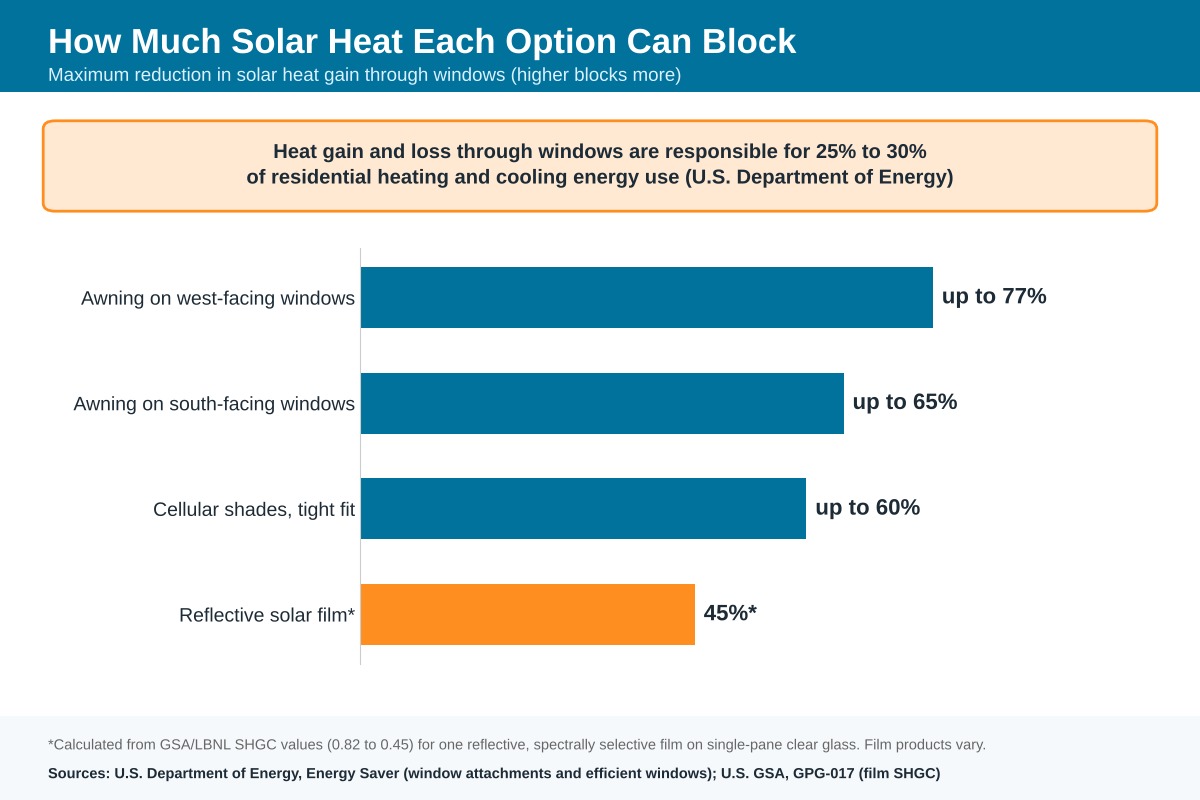
The U.S. Department of Energy tells homeowners to compare the solar heat gain coefficient (SHGC) and visible transmittance of each film, and a lower SHGC means better heat blocking. In a federal study, a reflective, spectrally selective film cut SHGC on single-pane clear glass from 0.82 to 0.45 while still passing about 67% of visible light. Films with stronger numbers cost more per square foot.
Glass Type and Compatibility
Glass decides which films are safe. Federal researchers found that heat-absorbing film on the room side of double-pane glass pushed interior glass surface temperatures as high as 140°F, and they did not find retrofit film cost-effective on double-pane bronze glass in most climates. Ask any installer for the film maker’s glass compatibility confirmation in writing.
Access, Pane Count, and Old Film
Tall entry glass, stairwell windows, and French doors with many small panes take longer to cut and fit. Removing old or failing film adds labor before the new film goes on.
Residential and Commercial Scope
Commercial buildings add volume discounts but also lifts, after-hours access, and coordination. Custom homes with large glass walls can be just as complex as an office.
Why Phoenix Glass Works So Hard
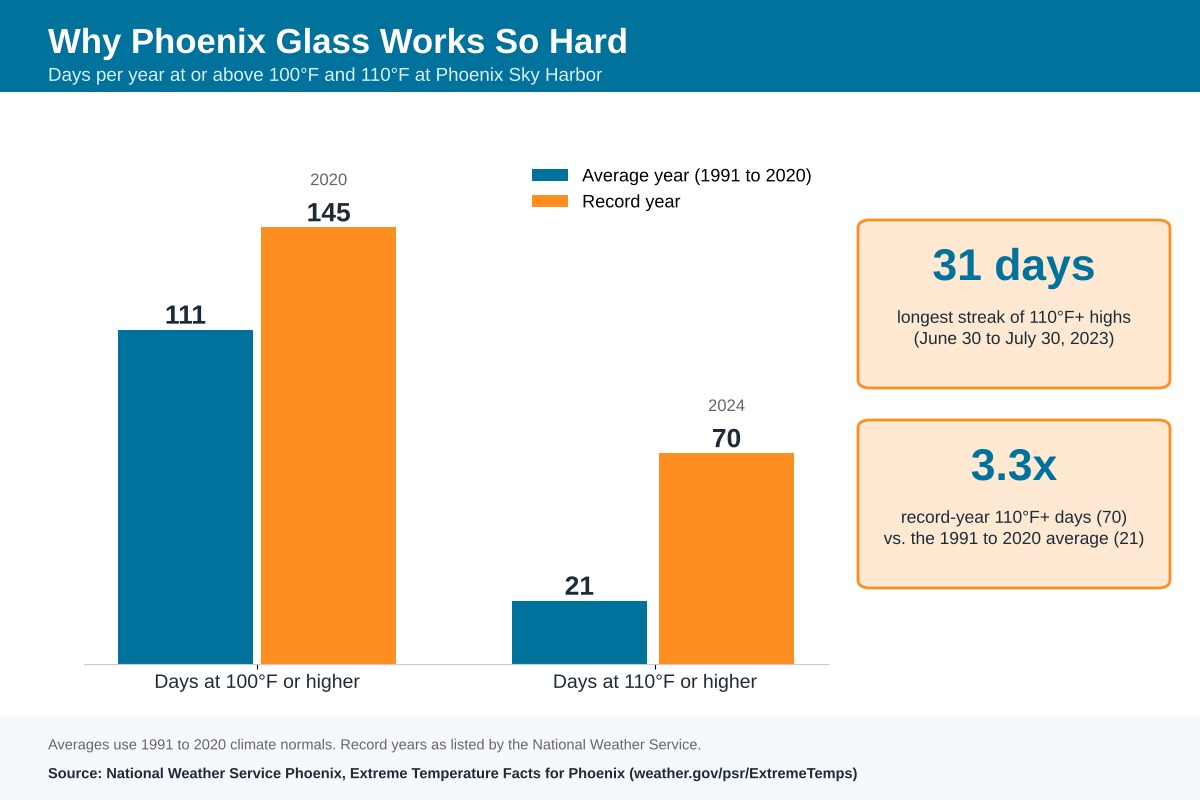
Phoenix Sky Harbor averages 111 days a year at 100°F or higher and 21 days at 110°F or higher, and the record year hit 70 days at 110°F or higher. Homeowners across the Phoenix metro communities we serve feel that load on every west- and south-facing window.
Does Solar Window Film Pay for Itself in Phoenix?
Federal modeling says yes for single-pane glass: a U.S. General Services Administration study with Lawrence Berkeley National Laboratory projected a 4.9-year payback for reflective solar film on single-pane clear windows in Phoenix.
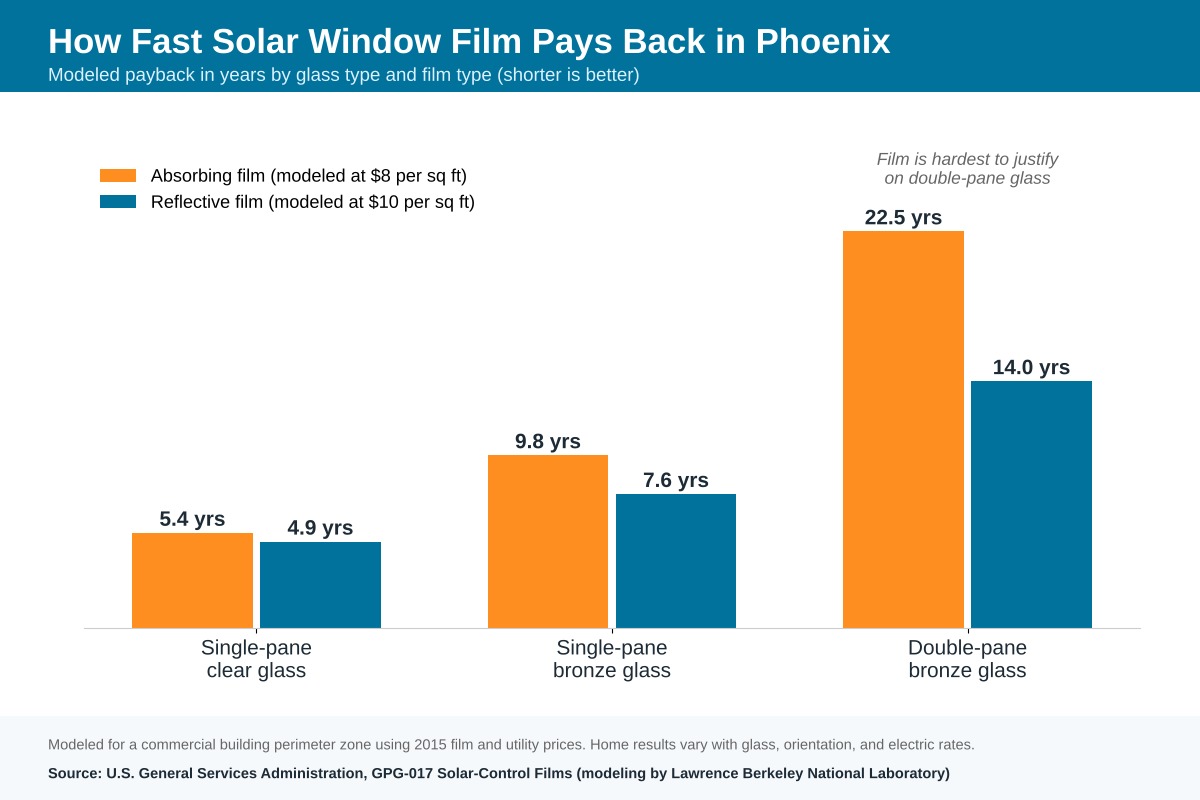
The study priced film at $8 to $10 per square foot and found reflective film cut HVAC energy use by up to 29% in warm climates with single-pane clear glass. Payback stretched to 7.6 years on single-pane bronze glass and 14 years on double-pane bronze glass, and absorbing film took longer in every case. The model covered a commercial perimeter zone at 2015 prices, so your home’s result will move with your glass, your orientation, and your electric rate.
Which Homes See the Fastest Payback?
Film pays back fastest where the sun load is highest and the glass is least efficient:
- Single-pane windows or older clear dual-pane glass
- West-, east-, and south-facing windows, which the Department of Energy singles out for film in hot climates
- Large glass areas such as sliders and picture windows
- Rooms that overheat by mid-afternoon
Newer low-e dual-pane windows already block part of the heat, so film adds less there and the payback is longer.
Window Film vs Window Replacement
The Department of Energy says that when existing windows are in good condition, improving them, with steps such as adding solar control film, may be the most cost-effective option. Replacement makes sense when frames leak, seals fail, or glass is damaged, and film does not fix any of those.
Window Film vs Solar Screens vs Other Window Treatments
Film works at the glass all day with no adjusting, while shades and screens let you control light and privacy.
| Option | How it cuts heat | Adjustable | Best for |
|---|---|---|---|
| Solar window film | Reflects or absorbs sunlight at the glass | No | Constant heat, UV, and glare control |
| Solar screens | Blocks sun while keeping the view | Roller or fixed panel | Glare and fading on view windows |
| Cellular shades | Up to 60% less solar heat with a tight fit | Yes | Insulation and privacy |
| Exterior awnings | Up to 77% on west windows, 65% on south | Fixed | Shading before sun hits the glass |
Many Arizona homes combine them. Film handles constant heat, and screen-style shades that keep the view or layered coverings for privacy and darkness handle the rest. If you want the full picture across every product, see the full price ranges for blinds, shades, and shutters.
DIY vs Professional Window Film Installation
DIY kits cost less up front, but bubbles, peeling, and poor clarity are common, and a kit rarely comes with labor coverage. Federal research lists commercially available applied films at 6 to 15 years of life, and that lifespan depends on clean prep, correct film, and a straight, tight edge.
- Professional film carries a manufacturer warranty plus installer labor coverage
- Installers match film to your glass type before cutting
- Clean, dust-free application avoids the bubbles that ruin DIY jobs
- A licensed contractor protects you if something goes wrong
Colby Window Solutions is licensed, bonded, and insured under Arizona ROC 342512.
How to Compare Window Film Quotes
Two quotes at the same price can cover very different products. Line them up on these points:
| Compare | Ask |
|---|---|
| Heat and light numbers | What are the SHGC and visible transmittance of the exact film? |
| UV rejection | What does the spec sheet list? Many quality films list up to 99%. |
| Glass compatibility | Will the film maker confirm it for my glass type in writing? |
| Warranty | How long does it run, and does it cover labor as well as film? |
| Scope | Does the price include old film removal, trimming, and every pane? |
| License | What is the contractor’s Arizona ROC number? |
| Price basis | Is it per square foot or flat, and is there a minimum charge? |
The lowest number is rarely the best value. A film with a better SHGC and a real warranty usually costs less over its life than a cheap film replaced in a few years.
Get an Accurate Window Film Quote in the Phoenix Area
The fastest way to a real number is to have the glass measured and the film matched to it. Request a film estimate and Colby Window Solutions will review your windows, orientation, and goals, then price the right film for each room. We are available Monday through Friday from 8 AM to 5 PM and Saturday from 8 AM to noon, and you can spread the cost with monthly payment options.
Prefer to talk it through in person? Visit the Mesa showroom to see samples, or book a phone or online consultation with the Florence office.
Request Your Window Film Estimate
Window Tinting Cost FAQs
How much does it cost to tint home windows in Arizona?
Window tinting in Arizona typically costs $10 to $25 per square foot installed. A 3 by 5 foot window runs about $150 to $375, and a 12-window home lands around $1,800 to $4,500 depending on film type and glass.
Is window tinting cheaper than replacing windows?
Yes, when your windows are in good condition and the problem is heat, glare, or UV. The Department of Energy lists solar control film as a way to improve existing windows in good condition, and it avoids the cost and disruption of replacement. Film does not fix leaking frames or failed seals.
How long does solar window film last?
Federal research lists commercially available applied films at 6 to 15 years. Arizona sun is harsh, so film quality and installation matter, and you should ask for the warranty length and whether it covers labor.
Will window film make my home too dark?
Not with a spectrally selective film. In a federal study, a reflective spectrally selective film on clear single-pane glass passed about 67% of visible light, compared with 88% for the bare glass, and the researchers described the finished appearance as essentially clear.
Can window film go on dual-pane windows?
Often yes, but it depends on the glass and the film. Federal researchers found heat-absorbing film on the room side of double-pane glass raised glass surface temperatures as high as 140°F, so confirm compatibility with the film maker before installation.
How much can window film lower my cooling costs?
Federal modeling found reflective solar film cut HVAC energy use by up to 29% in warm climates with single-pane clear glass. Results at your home vary with glass type, window direction, and your electric rate.
Which windows should I tint first?
Start with west-facing windows, then east- and south-facing glass. The Department of Energy recommends adding solar control film to east, west, and south windows in hot climates because those exposures gain the most heat.