

If you are comparing fabric samples, solar shade openness is the one number that tells you how much light, heat, and view will come through each of them. Openness is the percentage of the fabric that is open weave: a 5% fabric has 5% open space and 95% solid material. That small number controls glare on your screen, how clearly you can see the yard, how private the room feels during the day, and how hard your air conditioner works on an Arizona summer afternoon.
Most homeowners pick a shade by color or price and find out later: glare washing out a monitor, a living room that heats up by mid-afternoon, or a bedroom with no privacy once the lights come on. Our local installation team puts these fabrics in Arizona windows regularly, and the guidance below turns weave percentages into real choices for each room in your home.
Solar Shade Openness: What the Percentage Really Means
Think of the weave like a screen door. A tighter weave lets in less light and less view, and a looser weave lets in more of both. A tighter weave also stops more solar energy at the fabric, where it is absorbed or reflected instead of passing into the room. That matters a great deal in the desert: the U.S. Department of Energy reports that in cooling season, about 76 percent of the sunlight that hits a standard double-pane window enters the home as heat.
One detail worth knowing: openness describes the holes in the weave only. The fabric itself also passes a small amount of light, so the total light coming through is usually a little higher than the percentage suggests. It also means two fabrics with the same openness can look and perform differently, which is why color matters as much as the number.
How Roller Shade Openness Factor Is Measured
Engineers express the roller shade openness factor as a ratio from 0 to 1. A value of 0 is a completely opaque fabric, and 1 is a completely open mesh. In the Lawrence Berkeley National Laboratory study prepared for the Department of Energy, openness is defined as the ratio of holes to the overall area of the shade material. Most solar fabrics sold for homes fall between about 1% and 14%, and you will find them across our roller shade options.
That study modeled four generic roller shade quality levels so researchers could cover a wide range of fabrics. Level A has 0 openness, level B has 2%, level C has 5%, and level D has 30%. Each level also changes reflectance, emissivity, and how tightly the shade fits the window, with gaps modeled at 0 millimeters for a tight fit, 3 millimeters for a loose fit, and 12 millimeters for an extra-loose fit. In other words, openness is the headline number, but it never works alone.
How Much Heat Different Shade Fabrics Let Through
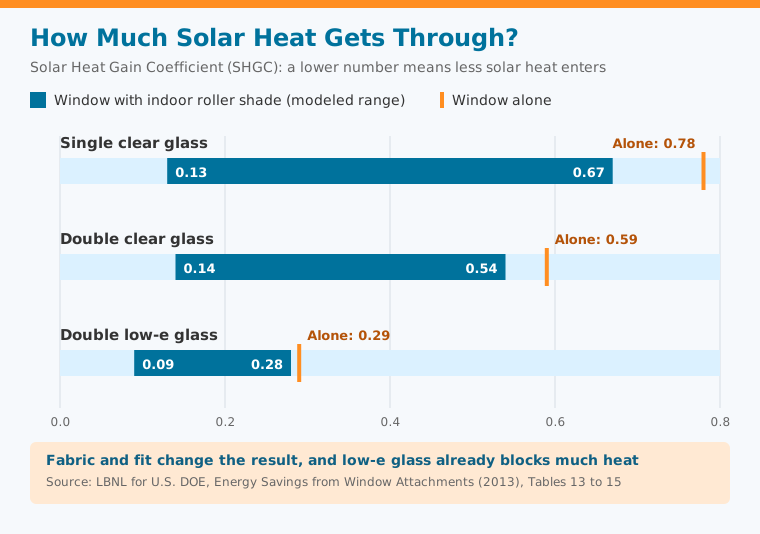
Source: Lawrence Berkeley National Laboratory for the U.S. Department of Energy, Energy Savings from Window Attachments, solar heat gain tables.
The numbers tell a clear story. On a double clear window, which starts at an SHGC of 0.59, adding an indoor roller shade brought the figure down to somewhere between 0.14 and 0.54 depending on the fabric and fit. On single clear glass, the range was 0.13 to 0.67 against a starting point of 0.78. A reflective, tightly fitted fabric lands at the low end of that range, while a dark, loose, very open fabric lands near the high end.
The better your glass already is, the less a shade has left to block. On double low-e glass, which starts at 0.29, the same shades ranged from 0.09 to 0.28. The researchers found that energy savings from window attachments were largest on single-pane aluminum windows and smallest on double-pane low-e vinyl windows. That is worth remembering in Arizona, where a national homeowner survey found that 46 percent of windows in the Southern climate zone are single pane. For those windows, the right shade fabric makes a big difference, and window film for glare and heat can add to it on older glass. The report also concludes that in cooling-dominated climates, window attachments save energy across the board.
Fabric Color and Openness: Getting the View You Want
Color changes how a fabric feels even when the openness is identical. Darker fabrics such as charcoal, bronze, and dark gray absorb light, so the fabric looks less bright from inside and your eye can pick out the outdoor scene more easily. The result is a crisper view through the shade, even at a lower openness. Lighter fabrics such as white, cream, and beige reflect more light and heat, which helps keep the room cooler, but they add a soft haze that makes the view slightly less sharp.
Screen glare is a separate problem from overall brightness. A light-colored 10% fabric can let in enough diffused light to wash out a monitor even when the room feels comfortable to your eyes. A dark 3% fabric cuts screen glare sharply and still leaves a usable view. The easiest way to see the tradeoff is to hold samples up to your own windows, and we bring them to you when we measure. If you want a look at the range of fabrics and colors, start with our solar roller shades.
Solar Shade Openness Comparison: 1%, 3%, 5%, and 10%
Each openness tier has its own performance profile, and the best way to choose is to match the tier to what each room is used for.
Quick Guide to Each Openness Tier
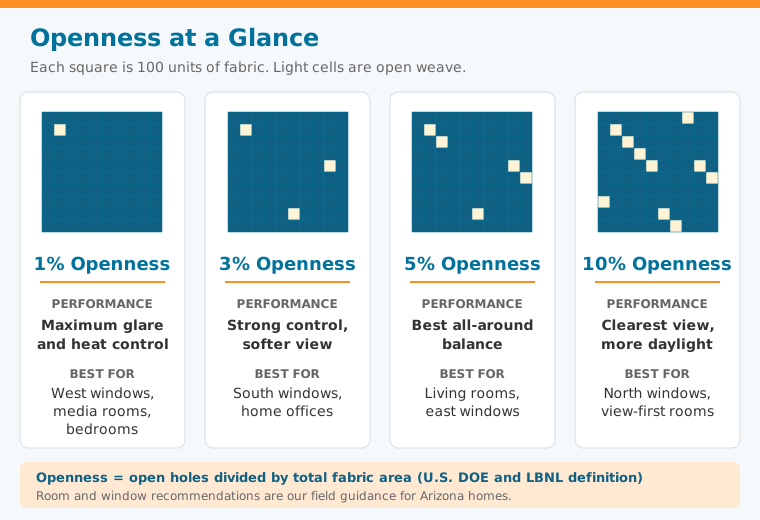
Openness definition: U.S. Department of Energy and Lawrence Berkeley National Laboratory. Room and window recommendations are our field guidance for Arizona homes.
- 1% openness: the tightest common solar weave, with the strongest daytime privacy, glare control, and UV protection. It suits media rooms, bedrooms, and west-facing windows that take the full force of the afternoon sun.
- 3% openness: excellent heat and glare reduction while starting to open up the outdoor view. South-facing windows and home offices with persistent screen glare are natural fits.
- 5% openness: the most popular all-around choice, balancing moderate privacy, meaningful glare reduction, and a clear view. Most living rooms and east-facing windows land here.
- 10% to 14% openness: the loosest weaves, built to maximize daylight and view. Privacy and heat protection drop considerably, so these work best on north-facing windows or wherever the view is the priority.
| Openness | Daytime View | Glare and Heat Control | Daytime Privacy | Typical Rooms |
|---|---|---|---|---|
| 1% | Limited | Highest | Highest | Media rooms, bedrooms |
| 3% | Good | High | High | Offices, south windows |
| 5% | Very good | Moderate to high | Moderate | Living rooms, east windows |
| 10% to 14% | Clearest | Moderate | Lowest | North windows, view-first rooms |
Why View-Through Changes After Dark
Solar shades work because your eye focuses on the brighter side of a semi-transparent surface. In daylight the outdoors is far brighter than your interior, so you can see out clearly while someone outside mostly sees the reflective surface of the fabric. The shade acts like a one-way screen because of relative brightness, not because of any special coating.
After dark, that reverses. When your lights are on and the outside is dark, your home becomes the brighter side, and anyone outside can see silhouettes or light shapes through the fabric while your view outward fades. Solar shades do not provide nighttime privacy at any openness. For rooms where privacy after dark is non-negotiable, we layer them with drapery, a blackout shade, or interior shutters and blinds for evening privacy, which gives you daytime view-through and full coverage at night.
Match Your Fabric to Window Orientation and Room
Using one openness percentage on every window almost always leaves some room unhappy. The rooms where you need a clear screen are not the rooms where you want a wide-open view, and a west-facing window in Arizona carries a far heavier solar load than a north-facing one.
Solar Shade Openness by Window Orientation
- West-facing windows: direct afternoon sun at peak intensity. A 1% or 3% fabric intercepts that heat before it enters the room.
- East-facing windows: bright morning light that is intense but shorter in duration. A 3% or 5% fabric handles the morning peak and keeps a pleasant view for the rest of the day.
- South-facing windows: steady exposure for most of the day, especially in summer. A 3% or 5% fabric provides the sustained protection this orientation needs.
- North-facing windows: soft, indirect light with little direct sun. A 10% fabric brings in the most natural light without the heat penalty it would carry on a south or west exposure.
Choosing Openness Room by Room
- Living rooms and kitchens: a 5% or 10% fabric keeps the connection to the outdoors while still filtering UV and glare.
- Bedrooms and media rooms: a 1% or 3% fabric puts light control and privacy ahead of the view.
- Home offices: a 3% weave usually eliminates monitor washout without making the room feel closed in.
Here is our rule of thumb: a 1% fabric works like sunblock for a west window, stopping glare and heat before they get into the room. Because shades only help while they are lowered, many customers add motorized solar shades on their hottest exposures so they close during peak sun without anyone having to remember. For more on layering fabrics and treatments across a whole house, see our guide to window treatments that handle Arizona sun.
Light Gaps and Installation Details That Make or Break Performance
A 1% fabric is only as effective as the installation around it. The most common performance problem is not the fabric but the light gap, the thin strip of unfiltered sun that leaks along the sides of an inside-mounted shade. On an intense west exposure, those strips can put a glare line on a monitor or a hot spot on the floor even when the shade is fully lowered. The Department of Energy researchers considered fit important enough to model tight, loose, and extra-loose installations separately.
An inside mount sits within the window casing for a clean look, but the roller hardware requires a small width deduction that leaves a gap on each side. An outside mount covers the trim and extends past the frame, which closes the gaps. In rooms where light control matters most, such as a media room or a west-facing bedroom, outside mounting is usually the better functional choice, even if the inside mount looks tidier. For an outside mount we generally extend the shade a couple of inches beyond the frame on each side and above the casing.
- Measure the width at the top, middle, and bottom of the casing, because window frames are rarely perfectly square.
- Use the narrowest width for an inside mount, then apply the deduction the hardware requires.
- Check the window depth and look for cranks, locks, and sensors that could block the shade.
- Plan layered coverings for any room that needs both daytime solar control and complete nighttime privacy.
Energy Savings, Rebates, and Budget
In its modeling, the Department of Energy and Lawrence Berkeley National Laboratory found that in cooling-dominated climates, window attachments reduce solar gain and lower energy use, which is the case across most of Arizona. How much you save depends on the glass behind the shade, the fabric, the fit, and how often the shade is closed. Heat-heavy homes tend to keep shades down more often. In the national household survey, 65 percent of coverings in the Southern climate zone were closed on summer weekday evenings, compared with 45 percent in the Northern zone.
Many of the window treatments we install may qualify for energy efficiency rebates through SRP or APS, depending on which utility serves your address. Ask us during your consultation which rebates apply to your home. To plan the investment, it helps to see what window treatments typically cost, and if you would rather spread the cost out, ask about our monthly payment options. If you are deciding between solar shades and other styles for the rest of the house, you can browse our full range of window treatments as well.
Common Questions About Choosing Your Fabric
A 1% openness shade has an extremely tight weave, with only 1% of the fabric surface open. It gives the strongest glare control, UV protection, and daytime privacy among solar shade fabrics, which makes it a good fit for media rooms, bedrooms, and west-facing windows. The fabric itself also passes a small amount of light, so the total light coming through is slightly higher than the openness number.
There is no single best percentage because the right choice depends on the room. A 1% to 3% fabric is best when glare and heat control come first. A 5% fabric is the most popular all-around choice because it balances view, glare reduction, and heat control. A 10% to 14% fabric is the right call when keeping an open view matters more than privacy or heat protection.
It means 5% of the fabric surface is open weave and the other 95% is solid material. In practice, a 5% shade keeps a clear view of the outdoors, cuts glare to a comfortable level in most rooms, and blocks a large share of incoming solar energy, which is why it is the default recommendation for living rooms and general-purpose windows.
During the day, a 1% shade offers strong privacy because the outdoors is much brighter than your interior. After dark, that flips. With lights on inside, people outside can see silhouettes or light shapes through the fabric while your view of the outdoors disappears. For full nighttime privacy, pair a solar shade with drapery, a blackout shade, or interior shutters.
Not by itself. A lower openness lets less sunlight pass through the weave, but fabric color and reflectance, how tightly the shade fits the window, and the glass behind it all affect the result. A shade protects the most on older single-pane glass and adds less on windows that already have low-e coatings.
Choose 3% for south-facing windows and home offices where glare and sustained sun are the main problems. Choose 5% for east-facing windows and living areas where you want a clearer view without giving up much heat control. Many homes use both, matching the percentage to each window instead of using one fabric everywhere.
Solar shades do not provide privacy at night when interior lights are on, they cannot create a true blackout for daytime sleeping or a home theater, and a very tight or light-colored fabric can soften the outdoor view. They are built for daytime glare, heat, and UV control, so rooms that need darkness should layer a blackout or room-darkening treatment with them.
Choose the Right Openness With Local Help
The right openness comes down to three things: which way the window faces, what the room is used for, and how much view you are willing to trade for heat and glare control. When we measure, we bring samples to each window, show you the difference between tiers in your own light, and pair the fabric with the right mount so the gaps do not undo the work.
Homeowners in the East Valley can see materials and finishes in person at our Mesa showroom, while our Florence office handles scheduling and consultations by phone and online for homeowners farther south.