

Solar shades for glare reduction work best when the fabric matches the room, not just the sun. The same shade that makes a living room comfortable can turn a home office into a dim cave, and a shade that tames a west window at 4 p.m. may do very little for a TV on the east wall. Glare is a brightness problem, and fixing it means choosing the right weave, color, and placement.
There is no single best fabric. Openness percentage is only one of several variables, alongside color, window direction, and what you do in the room. Here is how to sort through them so your windows stay bright, your view stays clear, and your screens stay readable.
Solar Shades for Glare Reduction: What Actually Controls Glare
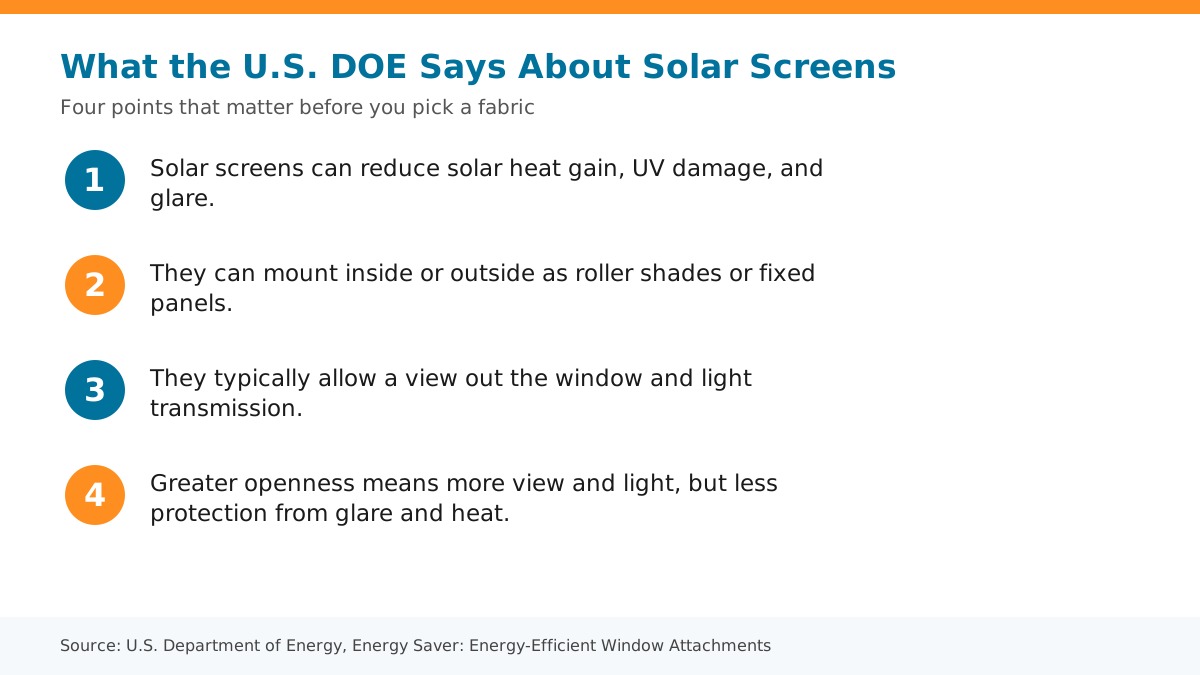
Glare happens when one part of your field of view is far brighter than the rest, such as a sunlit window behind a monitor. A solar shade reduces that contrast by letting only part of the sunlight through. The U.S. Department of Energy notes that solar screens can reduce solar heat gain, UV damage, and glare while typically allowing a view out the window and light transmission.
Three choices decide how well a shade handles glare: how open the weave is, what color the fabric is, and which way the window faces.
How Openness Changes Glare Control
Openness is the percentage of open space in the fabric. According to the Department of Energy, greater openness reduces protection against glare and solar heat gain while increasing visibility and light transmission. In practice, that gives you a simple ladder.
| Openness | Glare Control | View Out | Typical Rooms |
|---|---|---|---|
| 1% | Strongest | Heavily filtered, detail softens | Media rooms, home offices, west-facing bedrooms |
| 3% | Very strong | Recognizable outdoor view | West and south rooms, mixed-use living areas |
| 5% | Moderate | Clear view of landscaping | Living rooms, dining areas |
| 10% | Lightest | Closest to open glass | Shaded or north-facing windows, view-first rooms |
UV protection generally follows openness as well, so tighter fabrics tend to protect floors and furniture better. Ask for the manufacturer’s rating on any fabric you are considering rather than relying on a rule of thumb.
Fabric Color: Dark vs. Light
Many homeowners assume a light shade fights glare better because it looks bright. In most cases the opposite is true. Darker fabrics absorb light instead of scattering it, which reduces glare and gives a sharper view out. Lighter fabrics reflect more sunlight and heat, but they can give the room a soft glow when direct sun hits the fabric.
| Fabric Color | Glare | View Out | Heat | Best When |
|---|---|---|---|---|
| Dark (charcoal, bronze) | Lower, less glow | Sharper and clearer | Absorbs more heat into the fabric | Screen visibility and view matter most |
| Light (white, cream) | Soft glow in direct sun | Softer, less defined | Reflects more heat away | Heat is the bigger problem than glare |
Why Darker Is Not Always Cooler
Reflectance is the fabric property that matters for heat. In the federal modeling study, the best roller shade fabrics reflected about 80% of sunlight, while the weakest reflected about 5%. A dark 3% shade can win on glare and view, while a light 3% shade can win on heat. Neither is wrong. They solve different parts of the same problem.
Matching Solar Shades to Your Room and Window Direction
Room function is the most reliable guide to openness and color, and window direction decides how hard the shade has to work.
Choosing Solar Shades for Glare Reduction by Room
- Home offices and media rooms: 1% to 3% openness to calm screen glare and keep the room usable at peak sun.
- Living rooms and dining areas: 3% to 5% openness to stay bright while protecting floors and furniture.
- Kitchens and sunrooms: 5% to 10% openness to keep daylight and the outdoor view.
- Bedrooms: 1% openness for daytime glare control, paired with a second layer when you want evening privacy or full darkness for sleep.
If a room needs more than one job, layered window treatments let a solar shade handle the day while another layer handles the night.
West-Facing and East-Facing Windows
West-Facing Windows
West windows take late-afternoon sun at a low angle, which is the angle that hits monitors and TVs head-on. Tighter weaves, such as 1% or 3%, are the practical standard here, and a reflective or lighter fabric helps with heat.
East-Facing Windows
Morning sun creates glare early, right when many people are working or eating breakfast. Operable shades work well because you can keep them lowered in the morning and raise them once the sun climbs overhead.
South and North Windows
South windows get strong midday sun, so 3% fabrics handle them well. North windows rarely see direct sun, which makes 5% to 10% a good fit where preserving the view is the priority.
Get Free Fabric Samples at Home
What Federal Energy Modeling Shows for Hot Climates
Glare control and heat control go hand in hand, because both come from the same sunlight. A 2013 study by Lawrence Berkeley National Laboratory for the Department of Energy modeled window attachments in 12 U.S. cities, including Phoenix. It found that in cooling-dominated climates, all window attachments save energy because they lower the Solar Heat Gain Coefficient.
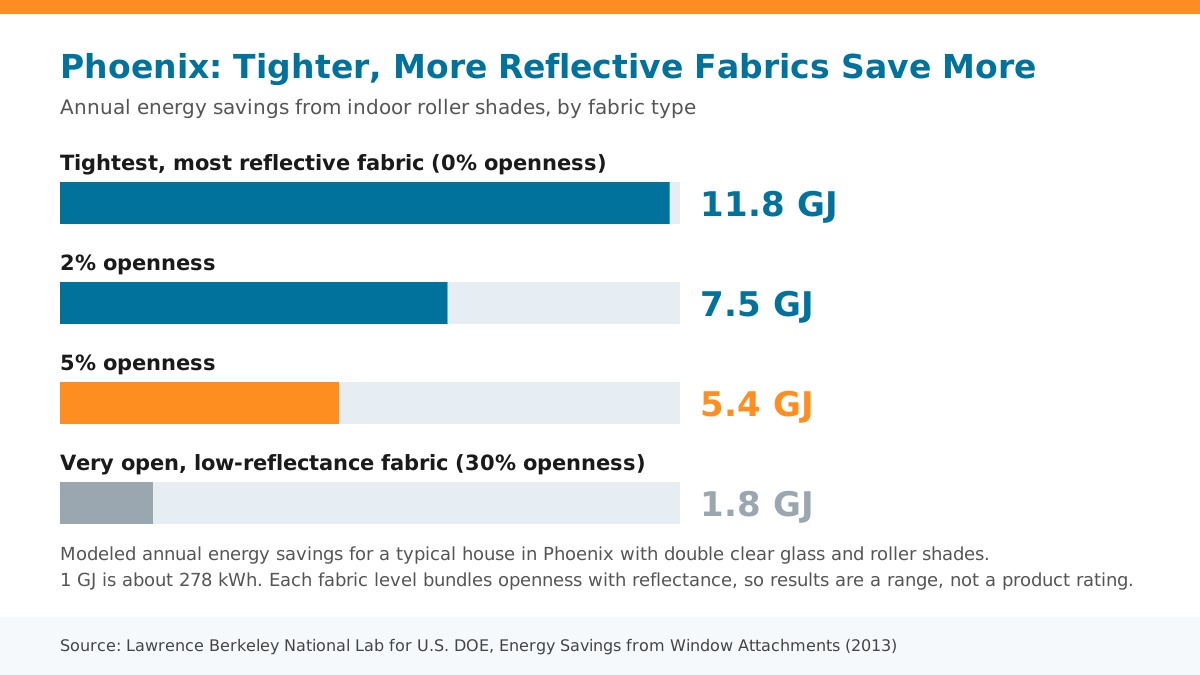
For a typical modeled house in Phoenix with double clear glass, indoor roller shades saved about 11.8 GJ per year with the tightest, most reflective fabric, 7.5 GJ at 2% openness, 5.4 GJ at 5% openness, and 1.8 GJ with a very open, low-reflectance fabric. The study defines each fabric level as a bundle of openness and reflectance, so treat these as a range rather than a rating for any one product.
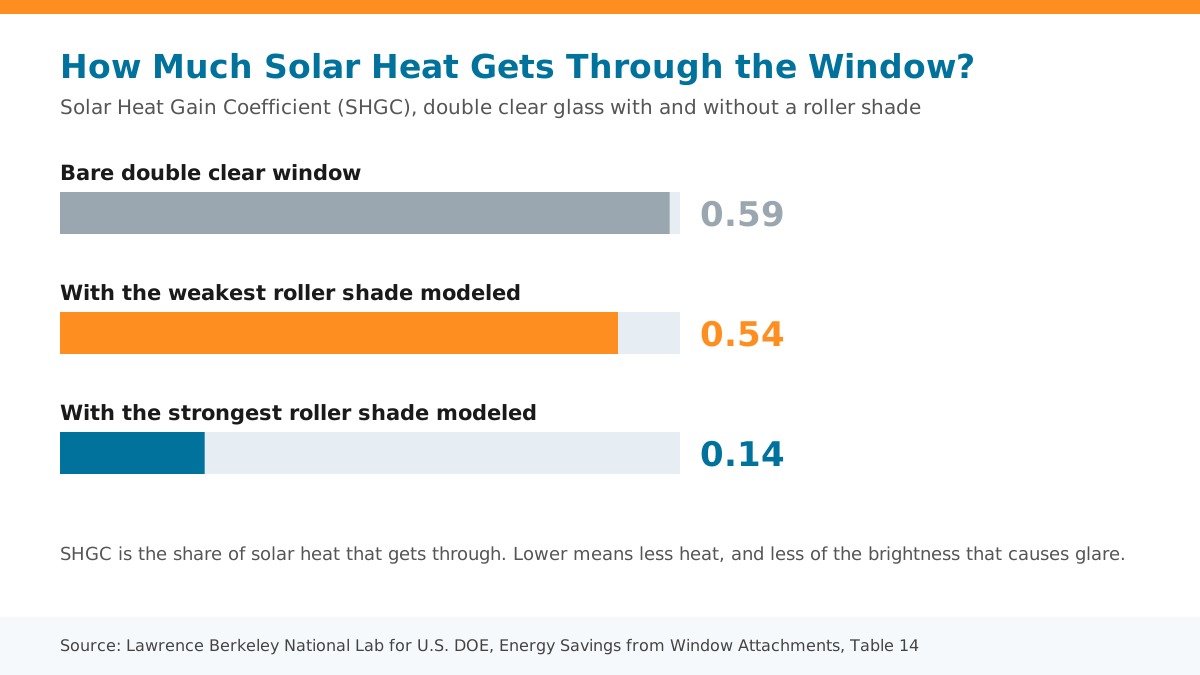
The same study reports that a bare double clear window has an SHGC of 0.59, while adding a roller shade lowers it to a range of 0.14 to 0.54 depending on the fabric. In plain terms, the right fabric can keep most of the sun’s brightness and heat from ever getting into the room.
- Tighter, more reflective fabrics performed best in Phoenix.
- Every attachment quality saved energy in the study’s South climate zone.
- How a shade is used matters. The study concludes that more responsive operation always improves performance, which is where motorization helps.
That last point is why automated shades that follow the sun are worth considering on west and east glass. They lower when the sun hits and raise when it passes, so the glare control happens whether or not anyone remembers to adjust the shade.
Choosing the Right Fabric the First Time
Test Samples at the Worst Hour
Judge a fabric by your room’s worst-case sun, not its average. A 5% light fabric can feel fine on a mild spring morning and still struggle at 3 p.m. in July. Hang samples at the actual window, check them at the brightest time of day, and look at the screen or seating spot you care about.
Interior Shades or Exterior Screens
Interior shades are easier to operate and come in more fabrics. For windows that take the hardest sun, consider exterior screens that stop heat at the glass. They are worth discussing for large west-facing glass, and we can walk through both options during a visit.
What a Free In-Home Measurement Covers
- Measuring each window and noting which way it faces.
- Showing fabric samples in your own light so you can compare openness and color.
- Matching the fabric to what each room is used for.
- Discussing manual, motorized, and layered options.
When you are ready, you can request a free in-home measurement, and we will bring samples to you. For planning, see what custom window treatments typically cost, and if spreading the cost helps, there are monthly payment options. If you are comparing styles for the whole house, the best window coverings for Arizona homes are worth a look alongside your fabric choice.
Serving the East Valley and Pinal County
We are a family-owned team that works with homeowners in the cities we serve across the East Valley and Pinal County, including Chandler and Queen Creek. Whether the problem is a west-facing home office or a sun-drenched great room, the right solar fabric is worth getting right once. You can browse the full range of weaves and colors in our custom solar screen fabrics.
Frequently Asked Questions About Solar Shades and Glare
What openness is best for glare on a computer or TV screen?
A 1% or 3% openness fabric is usually the better fit, because the tighter weave cuts more direct sunlight and softens the bright background behind a screen. Pair it with a darker fabric color for the sharpest view out while still reducing glare, and confirm the choice with samples at your own window.
Is a lower openness percentage always better for heat reduction?
Generally, yes. A tighter weave lets less sunlight through, which lowers solar heat gain. Fabric reflectance matters too: in the federal modeling study, the best roller shade cut the solar heat gain of a double clear window from 0.59 to 0.14, while the weakest only reached 0.54.
Do dark or light solar shades reduce glare better?
Darker fabrics generally cut glare and give a clearer, sharper view out, because they absorb light instead of scattering it. Lighter fabrics reflect more sunlight and heat but can create a soft glow when the sun hits them directly. The right color depends on whether glare or heat is your bigger problem.
How do I choose between 3% and 5% openness?
Choose 3% if glare on screens or intense afternoon sun is the main problem. Choose 5% if you want a clearer view of the yard and still need protection from fading and heat. If a room is torn between the two, hang both samples at the window and check them at the brightest time of day.
Can I motorize solar shades to manage sun exposure automatically?
Yes. Motorized shades can be scheduled to lower during the brightest hours and raise once the sun moves past the window. That matters because the U.S. Department of Energy reports about 75% of residential window coverings stay in the same position every day.
What is the difference between interior solar shades and exterior solar screens?
Exterior solar screens sit outside the glass and stop sunlight before it reaches the window, which generally makes them stronger on heat. Interior solar shades are easier to operate daily, protected from wind and weather, and available in more decorative fabrics. Both let you see out while reducing glare.
What about privacy after dark?
Solar shades are strongest in the daytime, when it is brighter outside than inside. After dark with lights on, the effect reverses and people outside can see in. If a room needs evening privacy, add a second layer such as drapery, a blackout roller shade, or shutters.
What Homeowners Are Saying
“Outstanding service; Professional and pleasant; competitively priced. And did I mention a fairly quick turnaround, from measurement to making the screens and finally installing. I highly recommend Colby Window”
Howard Gasch
“Ryan did an excellent job measuring and installing our sun screens. His knowledge of the SRP rebate program made it easy to submit the necessary paperwork and documentation. Ryan’s efficiency and knowledge were greatly appreciated. Thank you for your great customer service!”
Tom Jensen
“Ryan did a wonderful job on our sunscreens. Fair price, good workmanship, no fuss, no muss. He knows his products too. I would highly recommend this business. The way it should be!!”
Monte Passmore
Fix the Glare Without Losing Your View
The right solar shade tames glare, protects your furniture, and keeps your view. The wrong one makes the room dark or leaves the glare in place. Let our team at Colby Window Solutions match the fabric to your windows and rooms, and we will take the guesswork out of it.