


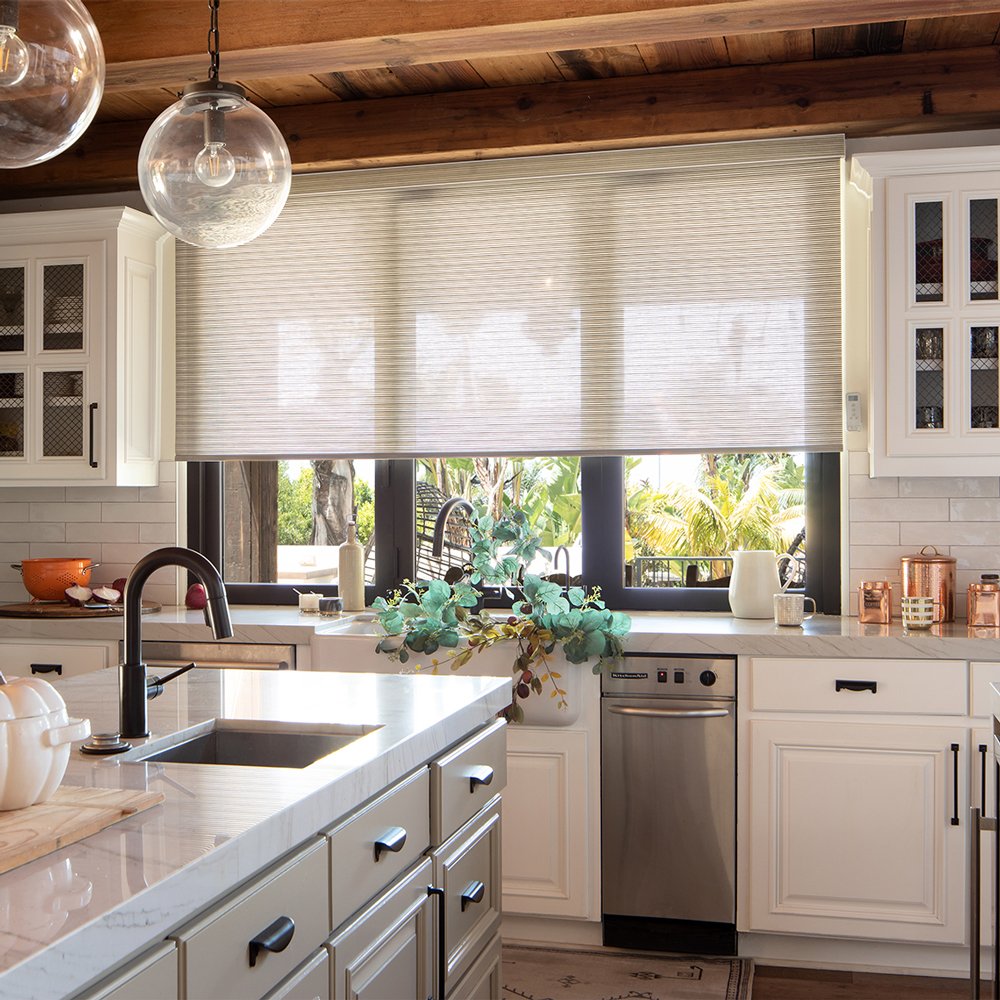
Choosing between inside vs outside mount blinds comes down to three things: how deep your window recess is, what hardware sits in the opening, and how much light and privacy you need. An inside mount sits within the window frame for a clean, built-in look. An outside mount attaches to the wall or trim and overlaps the opening, which closes off the light gaps that show up along the edges. Neither one wins every time, and most Arizona homes end up using both.
We hear the same frustrations from homeowners again and again: morning sun slipping down the side of a shade, a bedroom that never gets fully dark, or a shade that scrapes a window crank every time it moves. Nearly all of those problems trace back to a mounting decision made before anyone checked the depth of the frame and the hardware inside it. Our local installation team checks both on every job, and the guidance below is how we make the call for our customers.
Inside vs Outside Mount Blinds: The Key Differences
An inside mount secures the headrail within the window recess, so the blind or shade drops through the opening and the trim stays visible around it. An outside mount attaches to the wall or the trim above and around the window, so the covering sits in front of the entire opening. Inside mounts are about precision and a tailored look. Outside mounts are about coverage and flexibility.
The two styles are not equally common. A national survey of 2,100 households, analyzed in a U.S. Department of Energy report, found that about two-thirds of installed window coverings are mounted inside the frame, while roughly one-third are mounted outside. That split changes a lot by covering type. Blinds and shades lean heavily toward inside mounting, while curtains and drapery flip the other way, with about 74 percent hanging outside the frame.
Mounting Trends Across Blinds, Shades, Shutters, and Curtains
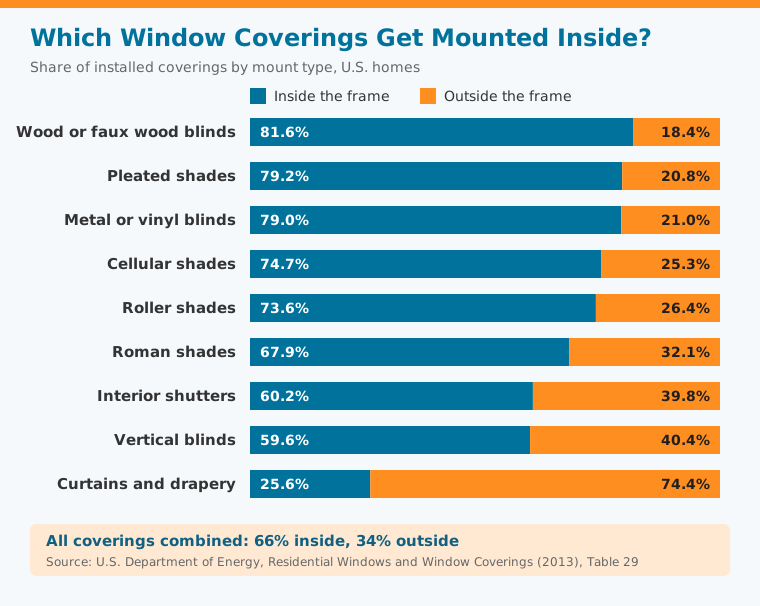
Source: U.S. Department of Energy, Residential Windows and Window Coverings, mount type by covering type.
Vertical blinds and interior shutters are the most evenly split of the blinds and shutters, with about 40 percent mounted outside the frame. That matches what we see in the field: wide openings, sliding doors, and shallow trim push those coverings toward an outside mount more often than a standard horizontal blind on a standard window.
Inside Mount Blinds for a Clean Built-In Look
Inside mount blinds work best when the window has enough depth and a clear opening. They show off your trim and keep the room looking uncluttered.
- The covering sits flush within the frame, so the window casing stays visible.
- The look reads as part of the architecture instead of something added on top.
- The covering takes up less visual space on the wall, which suits modern and minimalist rooms.
- Small operating clearances on each side allow smooth travel, but they also create thin edge gaps.
Outside Mount Blinds for Full Coverage and Hard-to-Fit Windows
Outside mount blinds overlap the opening, so they solve problems that an inside mount simply cannot.
- The covering extends past the opening on every side, which eliminates side light gaps.
- Older, uneven, or dated trim stays hidden behind the covering.
- Shallow frames are no longer a problem because the headrail mounts on the wall or trim.
- A wider or taller covering can make a small window look larger.
Inside Mount vs Outside Mount Shades: Matching the Look to Your Room
Aesthetics drive more of this decision than most homeowners expect, and the reason is simple: people rarely touch their window coverings. That same survey found that between 75 and 84 percent of coverings stay in the exact same position throughout the day. Whatever mount you choose will define how the room looks for years, whether the shade is closed, half open, or fully raised.
With inside mount vs outside mount shades, the national numbers lean toward inside: about 75 percent of cellular shades, 74 percent of roller shades, and 68 percent of Roman shades are mounted within the frame. Inside mounting keeps the trim in view and gives a tailored finish. Outside mounting is the better move when the trim is damaged or mismatched, when you want a shade to hang higher than the window to make it feel taller, or when the frame is too shallow to hold the hardware.
Fabric choice matters here too. Open-weave solar shades that cut glare and heat look sleek inside a deep frame, but the edge gaps are more noticeable against a bright window. If you are weighing fabrics and operating styles, our overview of roller shade styles and fabrics explains how each one behaves once it is mounted.
Light Gaps, Privacy, and Heat Control in Arizona
Every inside mounted blind or shade needs a small clearance on each side so it can travel up and down without rubbing the frame. That clearance is what creates a light gap. It does not matter how dark the fabric is: low-angle sun on east- and west-facing windows will find the gap. At night, the same gap can let people outside see a thin sliver of the room when the lights are on.
How Often Arizona Households Keep Shades Closed
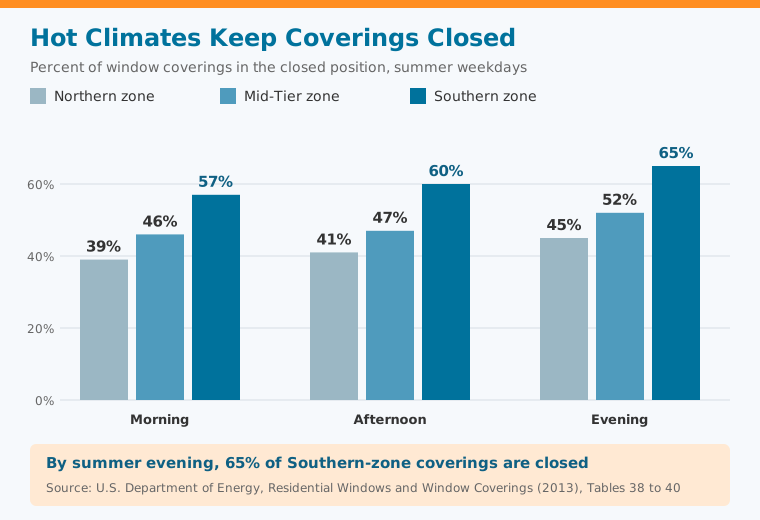
Source: U.S. Department of Energy, Residential Windows and Window Coverings, covering position by climate zone.
Heat changes how people use their windows. In that survey, which included Phoenix households in its Southern climate zone, 65 percent of coverings in that zone were closed on summer weekday evenings, compared with 45 percent in the Northern zone. When shades stay closed most of the day, as they do in the desert, edge gaps are on display for hours at a time instead of minutes.
Fit also drives energy performance. The Department of Energy notes that tightly installed cellular shades can reduce unwanted solar heat through windows by up to 60 percent in cooling season, and reduce winter heat loss by 40 percent or more. The key word is tight. A snug inside mount, or an outside mount with generous overlap, keeps air from moving freely around the edges. A loose fit of either type gives up part of that benefit.
For a closer look at which materials and layers hold up best against desert sun, see our guide to window treatments that stand up to Arizona sun. And if glare on the glass itself is part of the problem, window film for glare and heat works alongside any mounting style.
Inside Mount vs Outside Mount at a Glance
| Factor | Inside Mount | Outside Mount |
|---|---|---|
| Side light gaps | Small gaps from operating clearance | Overlap closes the gaps |
| Nighttime privacy | Good, with thin edge gaps | Maximum, full overlap |
| Window trim | Stays visible | Covered by the shade |
| Dated or damaged trim | Remains on display | Hidden |
| Frame depth needed | Enough to seat the headrail | None, mounts on wall or trim |
| Cranks, locks, and sensors | Must clear the shade path | Not an issue |
| Overall look | Tailored and built-in | Fuller, with more presence |
Room Darkening With Outside Mount Blinds and Shades
Room darkening is where outside mounting earns its place. A shade mounted outside the frame can extend past the opening on the top, bottom, and both sides, which creates a seal of coverage that an inside mount cannot match. For bedrooms, media rooms, and nurseries, that overlap is often the deciding factor.
Outside Mount Blinds for Bedrooms and Media Rooms
An inside mounted blackout shade with even a quarter inch of clearance on each side will still show a visible stripe of light along the frame. That stripe is enough to disrupt daytime sleep for a night-shift worker or wash out a screen in a media room. With outside mount blinds and shades, the overlap you choose controls the light, not the geometry of your window frame. We typically plan for an inch or two of overlap beyond the opening on each side and confirm the exact amount during measuring.
Frame depth plays a role with inside mounts as well. A deeper recess creates a longer shadow path, which makes edge gaps less noticeable. A shallow recess has almost no shadow buffer, so the gaps stand out more. Large outside mounted shades can be heavy to operate by hand, which is one reason many customers pair them with motorized shade options that raise and lower with a remote or a phone.
Matching the Mount to Your Windows
Inside vs Outside Mount Blinds by Window Type
Window style and construction narrow the choice quickly. Many stucco homes have thick walls and deeply recessed windows that are natural candidates for inside mounts, because the recess hides the headrail and the covering drops through a clean opening. Shallow frames and windows with hardware tell a different story.
| Window Type | Usually Best Mount | Why |
|---|---|---|
| Deep recessed windows | Inside | The recess seats the headrail and shows off the trim |
| Shallow frames | Outside | No room for a headrail without it sticking into the room |
| Casement windows with cranks | Outside | Clears the crank handle so the shade never snags |
| Double-hung windows with deep trim | Inside | Preserves the clean lines of the opening |
| Sliding glass doors | Often outside | Clears the handle and lets the covering span the full door |
| Windows with locks, sensors, or tile | Outside | Obstructions in the opening block an inside mounted shade |
Hardware and Obstructions to Check First
Window cranks, lock handles, security sensors, and tile backsplashes can all sit in the path of a descending shade. An inside mount that looks perfect on paper will snag or fail to close fully if any of those items intrude into the opening. In those situations, an outside mount is not just preferable, it is the only option that works. Interior shutters are the exception worth noting: they are built into the frame, and about 60 percent of them are inside mounted. If you are leaning toward that look, our interior shutters and horizontal blinds come with a full fit check before anything is ordered.
How to Measure for Inside Mount and Outside Mount Blinds
Accurate measurements are what separate a shade that fits beautifully from one that binds, gaps, or sticks out. A fraction of an inch can show up as a visible gap or a shade that rubs. Measure twice, and follow the manufacturer’s rounding rules exactly instead of rounding to a convenient fraction.
Measuring for an Inside Mount
- Measure the width inside the frame at the top, middle, and bottom, and record the narrowest number.
- Measure the height at the left, center, and right, and record the longest number so the shade reaches the sill.
- Check the depth of the recess to confirm it can seat the headrail you want.
- Look for cranks, locks, sensors, and tile that could block the shade.
Measuring for an Outside Mount
- Measure the outer edges of the trim to set your baseline width and height.
- Add overlap on each side, and extra above the window to cover the headrail.
- Confirm the wall or trim can hold the brackets securely.
- Decide whether you want the shade to hang higher than the window for a taller look.
Custom manufacturers deduct a small amount from the width of inside mount shades so they clear the frame, which means your shade arrives slightly narrower than the opening on purpose. We take care of those deductions for you. If you would rather skip the guesswork, you can schedule a consultation and we will measure every window and tell you which mount fits each one best.
Using Both Mounts in the Same Home
Many homes need a combination. A living room with deep recessed windows might get inside mounted shades for a tailored look, while the master bedroom gets outside mounted blackout shades for total darkness. That is completely normal, and it is easy to keep the rooms looking consistent by choosing the same fabric family throughout. We install our full range of window treatments, so mixing mounts, fabrics, and operating styles in one home is simple to coordinate.
For a sense of budget, it helps to see what window treatments typically cost before you decide how many windows to do at once. If you would rather spread the cost, ask about our monthly payment options.
Inside vs Outside Mount Blinds: Common Questions
Inside mounts are the usual choice. About 75 percent of cellular shades nationwide are mounted inside the frame, and a snug fit helps trap insulating air against the glass, which is where the energy savings come from. If your main goal is total room darkening instead of energy performance, an outside mount is the stronger option because it overlaps the frame and removes side light gaps.
Inside mounts look more contemporary and tailored because they sit flush and leave the trim visible. Outside mounts look better when the frame is old or uneven, when you want to block side light, or when you want a small window to look bigger by extending the covering past the trim.
No. An inside mount needs enough frame depth to seat the headrail, and the opening must be clear of cranks, locks, sensors, and other hardware. Shallow frames and windows with obstructions almost always need an outside mount. Different styles need different minimum depths, so we confirm the requirement for the exact covering you choose.
Outside mounts cover the trim, so you lose that architectural detail. They also stand out more from the wall and need a solid surface for the brackets. On very small windows, an oversized covering can look bulky. The upside is full coverage, better privacy, and fewer light gaps.
Most roller shades, about 74 percent nationwide, are mounted inside the frame because the headrail is compact and the look is clean. Choose an outside mount if the frame is shallow, if hardware is in the way, or for sliding glass doors where the shade needs to clear the handle and cover the full opening.
Yes, a little. Inside mounted shades need a small clearance on each side to operate smoothly, and low sun can slip through those gaps. An outside mount with generous overlap removes the gaps. For rooms where you only want a softer edge, the clearance is usually not noticeable.
For wide openings, they remain one of the most practical choices because they travel across the full span and can be adjusted for light and privacy. Vertical blinds are split fairly evenly between mount types, with about 60 percent inside and 40 percent outside. Modern fabric vanes and cleaner tracks look far better than the heavy plastic versions many people remember.
Get the Right Mount the First Time
Inside or outside, the best mount is the one that fits your window depth, clears your hardware, and gives you the light control you need. Deep, clean frames favor inside mounts. Shallow frames, crank windows, and bedrooms that need real darkness favor outside mounts. We will walk through every window with you and match each one to the right style.
Homeowners in the East Valley can see materials and finishes in person at our Mesa showroom, while our Florence office handles scheduling and consultations by phone and online for homeowners farther south.