

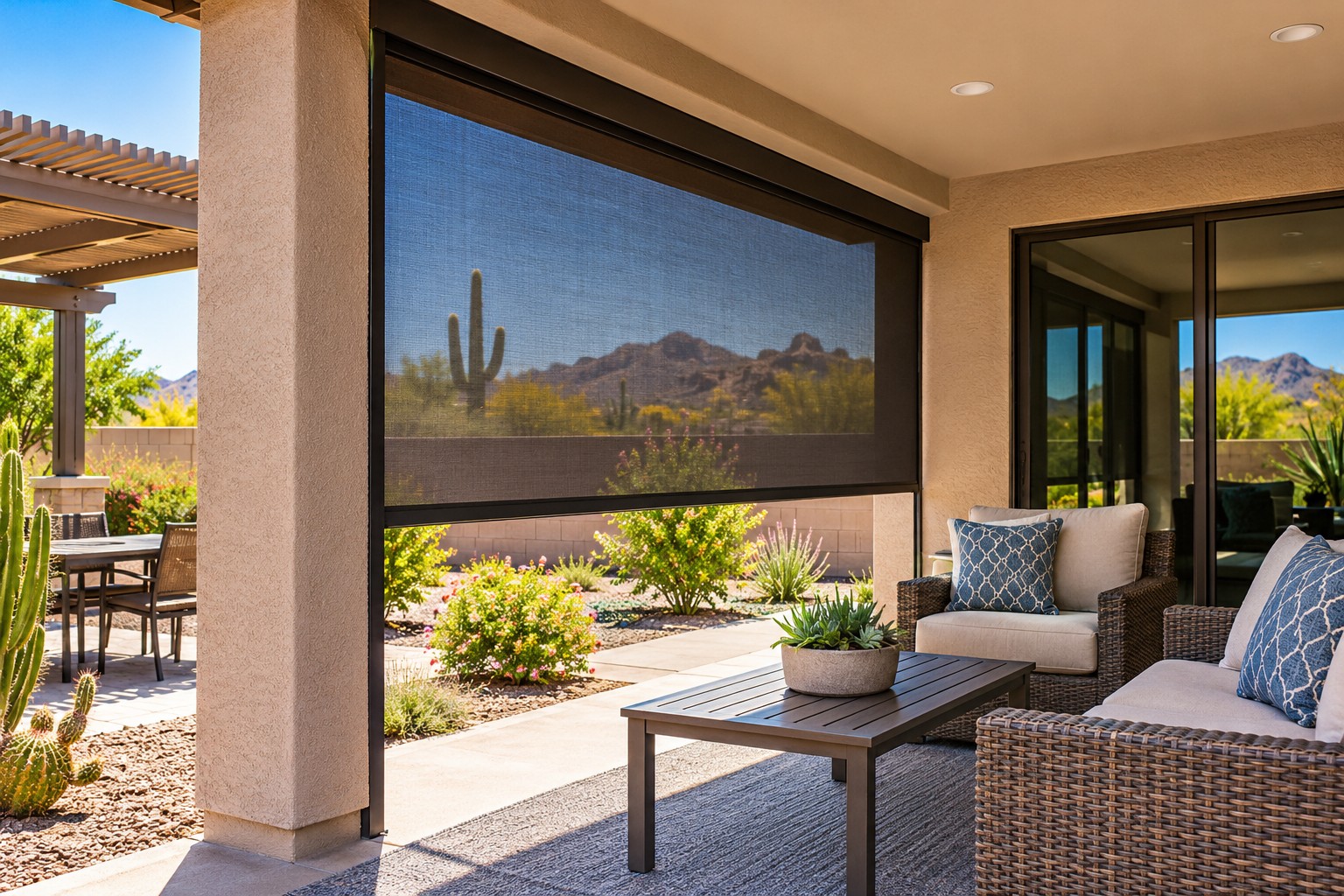
Outdoor patio shades in Arizona have one job: make a patio usable when the sun is at its worst. A west-facing patio can be too hot to sit on by 3 PM, and the glass doors behind it pour that heat into your living room. The right shade fixes both, and the right choice depends on sun direction, wind, and how much control you want.
Since 2009, Colby Window Solutions has helped Arizona homeowners shade their windows and outdoor living areas. The comparisons, costs, and rebate details below come from federal research, utility programs, and published Phoenix pricing.
What Are the Best Outdoor Patio Shades in Arizona?
The best outdoor patio shades in Arizona are exterior solar shades for most patios, because they block heat and glare while keeping your view. Retractable awnings and pergola covers add overhead shade, and the right pick depends on sun direction, wind exposure, and budget.
Exterior solar shades and roll-down shades hang on the outside of a patio opening and stop sunlight before it reaches the glass or the seating area. Our exterior patio shade installation covers solar screens, roll-down shades, and manual or motorized operation. Overhead structures such as awnings and pergolas shade the floor and furniture, and they work well alongside vertical shades on the low-angle sides.
| Option | Heat and glare control | Adjustable | Best for |
|---|---|---|---|
| Exterior solar shades | Blocks sun before it hits glass, keeps the view | Yes, roll up or down | West and south openings, patio doors, glare |
| Retractable awnings | Overhead shade, up to 77% less solar heat gain on west windows (DOE) | Yes | Shading seating areas and windows together |
| Pergolas with shade | Partial overhead shade, depends on slats or cover | Some designs | Defined dining or lounge zones |
| Fixed patio covers | Constant overhead shade | No | All-day coverage, rain protection |
| Shade sails | Overhead shade, minimal enclosure | No | Modern designs on a smaller budget |
Exterior Solar Shades for Patios
Exterior solar shades are the most practical choice when you want shade without losing the view. The Department of Energy notes that solar screens reduce solar heat gain, UV damage, and glare, and that exterior shading is among the most effective ways to cut solar heat gain. Because the fabric sits outside the glass, the heat never gets into the room.
- Cuts heat on the patio and on the doors and windows behind it
- Protects furniture, flooring, and cushions from UV fading
- Keeps a view through the fabric, depending on openness
- Rolls up when you want full sun or an unblocked view
Outdoor Patio Shades in Arizona: Fixed vs Retractable
Fixed shade gives constant coverage with little maintenance but no flexibility. Retractable shade lets you change coverage by season and time of day, which suits Arizona, where you want maximum shade in July and sunlight in January.
- Fixed (covers, solid pergola roofs): consistent shade, durable, and the same level of coverage in every weather condition
- Retractable (roll-down shades, awnings): adjustable coverage, can be retracted in cooler months or when wind picks up, and available with manual crank or motor operation
The Department of Energy also notes that awnings need ventilation so hot air does not get trapped, and that they can increase heating energy use in winter. Retractable options can be rolled up to let the winter sun in.
How Much Heat Can Outdoor Shades Block?
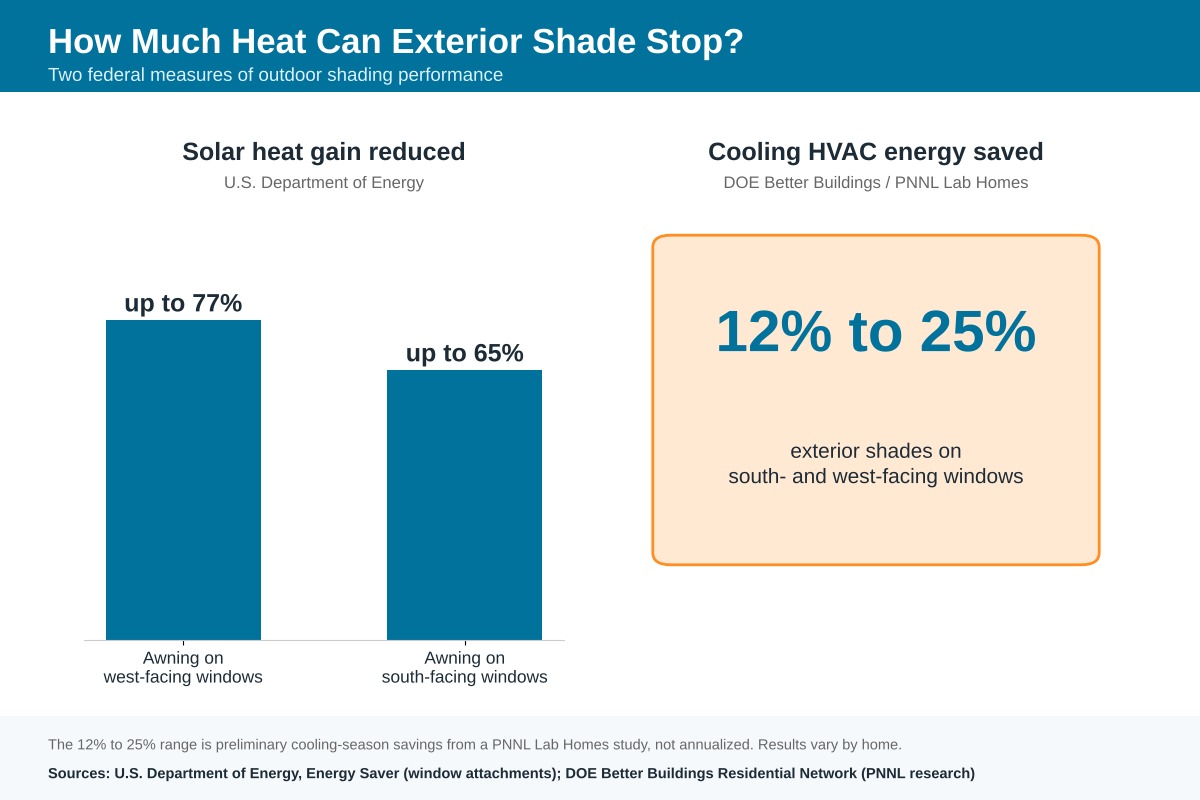
Awnings reduce solar heat gain by up to 77% on west-facing windows and up to 65% on south-facing windows, according to the Department of Energy. In Pacific Northwest National Laboratory test homes, exterior shades saved 12% to 25% of cooling energy on south- and west-facing windows in a preliminary cooling-season study.
The Salt River Project says about 50% of the heat that enters a home comes through the windows, which is why shading the glass behind a patio pays off twice: once for patio comfort and once for your cooling bill.
Which Fabric Openness Is Best for a Patio Shade?
Openness factor is the percentage of the fabric that is open weave. The Department of Energy notes that a higher openness factor allows more view and light but gives less protection from glare and solar heat gain. Compare fabrics in our screen-style shade fabrics before you decide.
| Openness | What you get | Best for |
|---|---|---|
| Low (1% to 3%) | Strongest heat and glare control, more privacy, darker view out | West and south exposures, hottest patios |
| Medium (5%) | Balanced heat control and visibility | Mixed exposure patios |
| High (10%) | Clearest view, softer light, less heat blocked | Shaded or east-facing patios with a view to protect |
How Much Do Outdoor Patio Shades Cost?
Patio shade cost depends heavily on the type. Angi’s Phoenix awning guide reports awnings at $6 to $30 per square foot for materials and installation, with fixed awnings at $310 to $2,590 per project and motorized retractable systems at $1,040 to $10,400. For pergolas, Angi’s Phoenix pergola guide lists aluminum and vinyl at $10.25 to $31 per square foot.
For a 12 by 15 foot patio (180 square feet), those per-square-foot ranges work out to:
| Option | Rate per sq ft | Estimated cost for 180 sq ft |
|---|---|---|
| Awning, materials and installation | $6 to $30 | $1,080 to $5,400 |
| Aluminum or vinyl pergola | $10.25 to $31 | $1,845 to $5,580 |
| Exterior solar shades | Priced per opening by size, fabric, and controls | Quoted after measuring |
Exterior solar shades are priced per opening, so a measured quote is the only reliable number. For comparisons across window and patio products, see the full price ranges for blinds, shades, and shutters.
Does the SRP Rebate Cover Outdoor Shades?
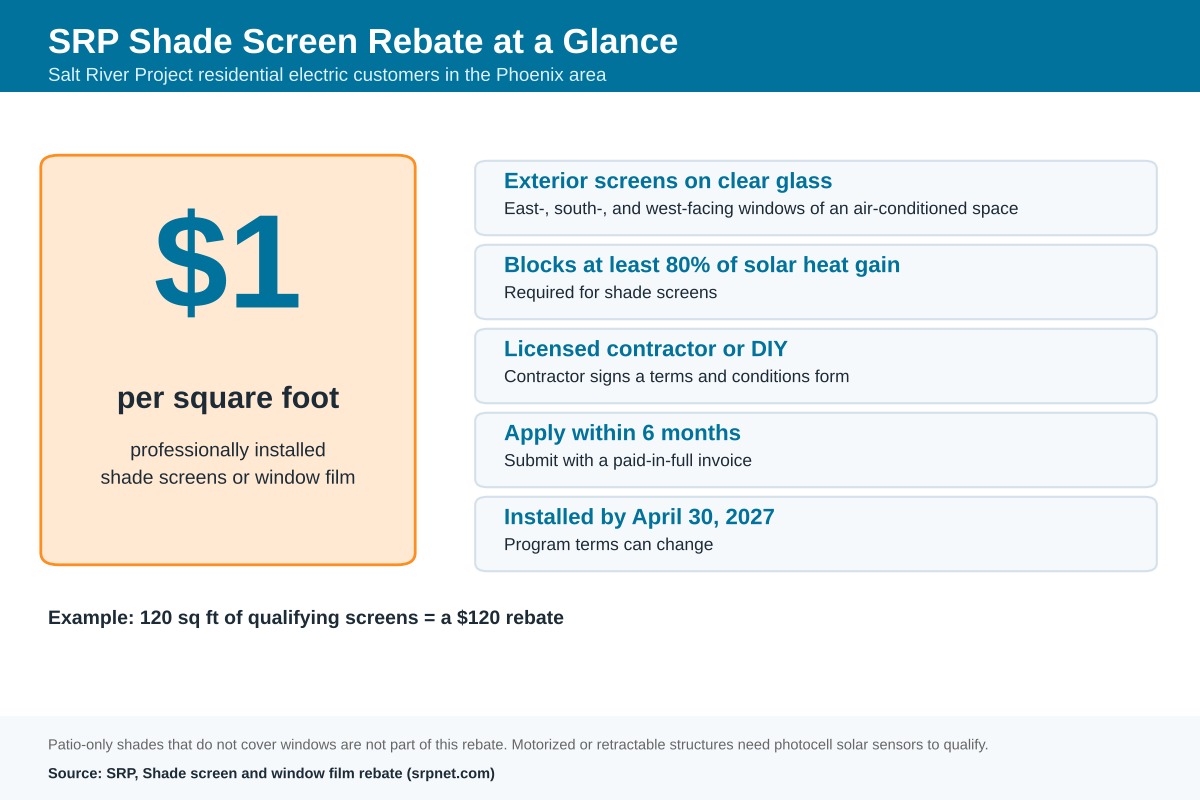
Partly. SRP pays $1 per square foot on professionally installed exterior shade screens, but only on east-, south-, and west-facing windows of an air-conditioned space, so a shade that covers only an open patio does not qualify.
To qualify, screens must block at least 80% of solar heat gain, go on the exterior of clear glass, and be installed by a licensed contractor or DIY by April 30, 2027, with the application submitted within six months. Motorized or retractable shade structures qualify only when installed with photocell solar sensor equipment. A patio door and two windows totaling 120 square feet of qualifying screens would earn a $120 rebate. Colby Window Solutions is an SRP contractor, and we can tell you at the estimate which openings qualify.
Materials That Hold Up in Arizona Sun and Monsoon Wind
Arizona sun breaks down cheap fabric and hardware fast, so materials matter more than looks. The Department of Energy recommends synthetic awning fabrics such as acrylic and polyvinyl laminates that are water-repellent and treated to resist mildew and fading, in an opaque, tightly woven, light color that reflects more sun.
- UV-stable fabric: keeps color and strength under constant sun
- Rust-resistant hardware: aluminum or treated steel for brackets and frames
- Tight, correct fit: side channels or cables limit flapping in wind
- Retractability: lets you roll shades up before strong monsoon wind
- Ventilation: overhead shade needs airflow so heat does not trap beneath it
Best Patio Shade by Sun Exposure
Sun direction decides which shade does the most work. The Department of Energy singles out west- and south-facing exposures for exterior shading, because they gain the most heat.
| Exposure | Best approach |
|---|---|
| West-facing patio | Low-openness exterior solar shades or an awning, since this side gains the most heat |
| South-facing patio | Overhead shade plus exterior shades on the glass behind it |
| East-facing patio | Medium or high openness exterior shades to cut morning sun and keep the view |
| North-facing patio | Little heat gain, so choose shade for glare or privacy only |
| Pergola or covered patio | Vertical exterior shades on the open sides where low sun comes in |
Common Patio Shade Mistakes to Avoid
- Picking by appearance before checking sun direction
- Choosing fabric openness without thinking about the view you want to keep
- Ignoring wind and monsoon exposure on open patios
- Buying low-quality fabric or hardware that fades or rusts within a few seasons
- Skipping a licensed installer, which can also cost you the SRP rebate
Get a Patio Shade Quote in the Phoenix Area
The most accurate answer comes from measuring your openings and checking sun direction. Request a patio shade estimate and Colby Window Solutions will review your patio, recommend a shade type, and price each opening. We are licensed, bonded, and insured under Arizona ROC 342512, and you can spread the cost with monthly payment options.
Prefer to see samples in person? Visit our Mesa showroom, or book a phone or online consultation with the Florence office. We serve communities across the Phoenix metro and are available Monday through Friday from 8 AM to 5 PM and Saturday from 8 AM to noon.
Request Your Patio Shade Estimate
Outdoor Patio Shade FAQs
What are the best outdoor patio shades in Arizona?
For most patios, exterior solar shades are the most practical choice because they block heat and glare while keeping the view. Awnings and pergola covers add overhead shade, and many Arizona patios combine overhead shade with vertical shades on the low-sun sides.
How much do outdoor patio shades cost?
It depends on the type. Angi’s Phoenix guide reports awnings at $6 to $30 per square foot installed, and aluminum or vinyl pergolas at $10.25 to $31 per square foot. Exterior solar shades are priced per opening, so a measured quote gives the real number.
Does the SRP rebate cover patio shades?
Only when the shade is an exterior screen on east-, south-, or west-facing windows of an air-conditioned space. SRP pays $1 per square foot, requires screens that block at least 80% of solar heat gain, and does not cover shades that only cover an open patio. Check current terms with SRP, since they can change.
Are retractable patio shades better than fixed ones?
Retractable shades are more flexible because you can lower them in summer and raise them in cooler months or before strong wind. Fixed shade gives constant coverage with less maintenance but cannot adapt. The Department of Energy notes that awnings can increase heating energy use in winter, while retractable ones can be rolled up.
Can patio shades handle Arizona wind?
Well-built systems can, especially with side channels or cables, strong hardware, and the option to retract before monsoon winds. Wind exposure varies by property, so confirm wind performance for your site with the installer.
How much cooler will a shaded patio and home be?
The Department of Energy says awnings can reduce solar heat gain up to 77% on west-facing windows and up to 65% on south-facing windows. In PNNL test homes, exterior shades saved 12% to 25% of cooling energy on south- and west-facing windows in a preliminary study. Results vary by home.
Which fabric openness should I choose?
Low openness (1% to 3%) gives the most heat and glare control for hot west and south exposures, while higher openness (5% to 10%) keeps more view and light with less heat blocked. The Department of Energy notes that greater openness reduces protection from glare and solar heat gain.