

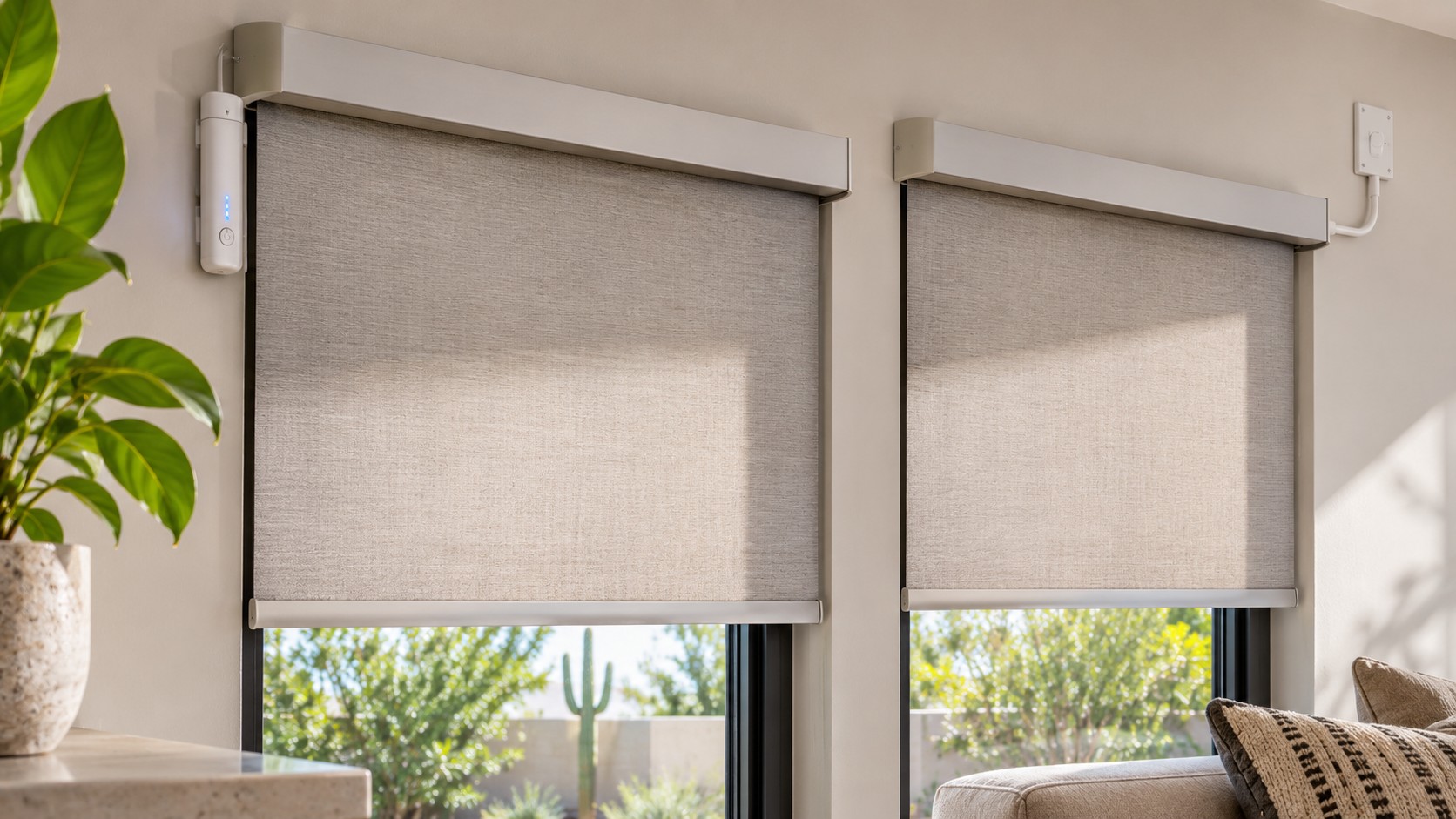
The right choice in battery vs hardwired smart shades depends on your walls and your windows: battery-powered shades install in finished homes with no wiring, while hardwired shades suit new construction, remodels, and larger or grouped shades. Each has a real tradeoff, and the wrong pick shows up later as either battery chores or a wall repair bill.
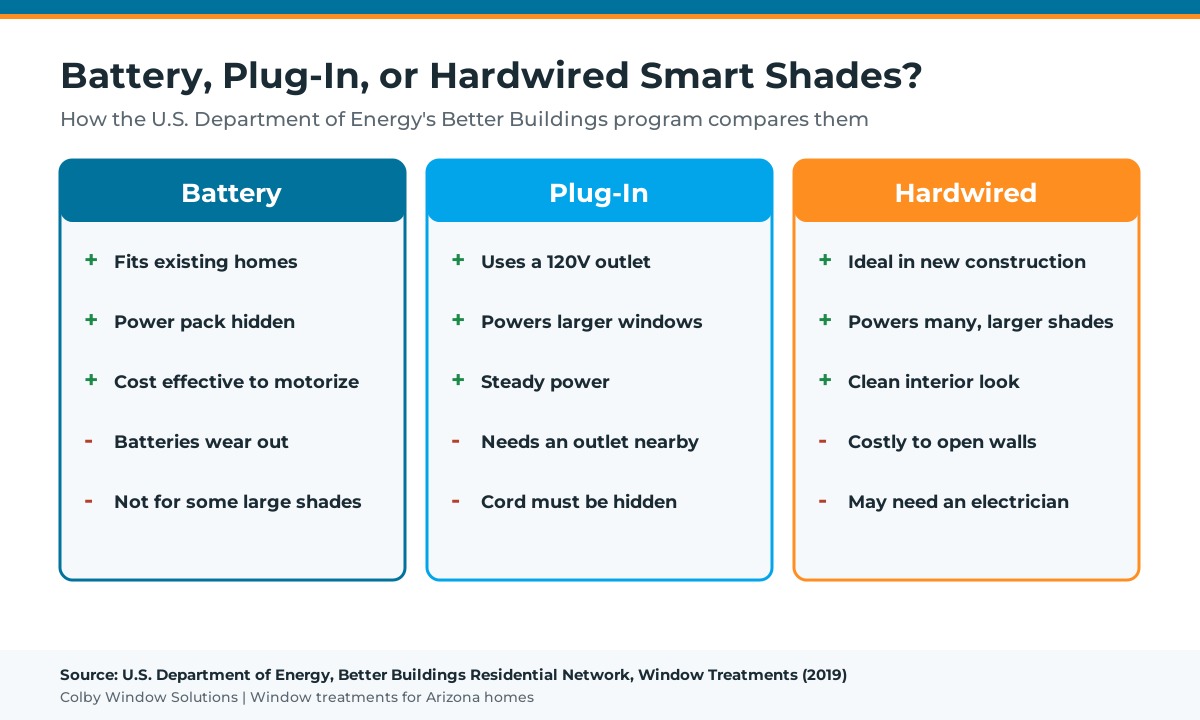
The U.S. Department of Energy’s Better Buildings program sorts smart shade power into three types: battery, plug-in, and hardwired. Most homeowners only hear about two of them, so this guide covers all three, along with battery life, cost drivers, outage behavior, and which setup fits Arizona homes best.
What Is the Difference Between Battery and Hardwired Smart Shades?
Battery smart shades run on batteries stored in the headrail or a slim wand and need no wiring, while hardwired smart shades connect to low-voltage wiring and a power supply that you never have to recharge. A third option, plug-in shades, runs from a nearby 120V outlet through a transformer.
| Battery | Plug-in | Hardwired | |
|---|---|---|---|
| Power source | AA, lithium, or rechargeable wand | 120V outlet and transformer | Low-voltage wiring to a power supply |
| Installation | Mounts like a manual shade | Needs an outlet near the window | Wiring run before or during install |
| Upkeep | Recharge or replace batteries | None for power | None for power |
| Best for | Finished homes, retrofits | Rooms with an outlet and a clean cord path | New builds, remodels, large or grouped shades |
| Main limit | Battery life, some large shades | Visible cord if not planned | Cost of opening walls in existing homes |
Battery-Powered Smart Shades
Battery-powered shades hide the power pack in the headrail or a wand that clips in behind it. Depending on the brand, that means AA cells, lithium cells, or a rechargeable battery. Hunter Douglas, for example, says its rechargeable battery wand fully recharges in 2 to 3 hours. The shade mounts like any other, so installation is quick and the walls stay untouched.
Plug-In Smart Shades
Plug-in shades use a transformer on a standard outlet, which gives steady power and can handle larger windows. The catch is placement: you need an outlet close to the window and a plan to hide the cord behind drapery, under a valance, or by placing an outlet inside the shade pocket.
Hardwired Smart Shades
Hardwired shades connect through low-voltage wiring to a central power supply, which gives the cleanest look and can power several shades and larger sizes. The best time to do it is during construction. In an existing home, opening walls can be costly, and depending on local rules the wiring may need a licensed electrician.
Battery vs Hardwired Smart Shades: Pros and Cons
Battery shades win on installation and upfront cost, and hardwired shades win on maintenance and capacity for bigger jobs. Here is how the two compare on the factors that decide most purchases.
| Factor | Battery-powered | Hardwired |
|---|---|---|
| Installation | No wiring, no wall repair | Wiring required, easiest with open walls |
| Upfront cost | Lower, with no electrical work | Higher, with wiring, power supply, and labor |
| Ongoing cost | Batteries to recharge or replace | None for power |
| Large or grouped shades | Not suited to some large shades | Can power several shades and larger sizes |
| Look | Power pack hidden in the headrail | No batteries or cords visible |
| During a blackout | Keeps working | Stops until power returns |
- Battery pros: clean retrofit, lower upfront cost, and freedom to place a shade anywhere.
- Battery cons: batteries wear out, and heavier shades or shades that move often drain them faster.
- Hardwired pros: no battery chores, steady power, and capacity for large or grouped shades.
- Hardwired cons: wiring through finished walls is disruptive unless the studs are already open.
Battery vs Hardwired Smart Shades for Retrofit and New Construction
The condition of your walls decides this more than any other factor. In a finished home, battery-powered shades are usually the practical choice because they skip the drywall or stucco cuts, patching, and repainting that wiring would need. In new construction or a major remodel with exposed studs, adding low-voltage wiring costs little by comparison, so hardwiring becomes the better long-term setup.
Homeowners in established neighborhoods in Mesa, Gilbert, Queen Creek, and across the East Valley often choose battery power for exactly this reason, while newer builds in Chandler and San Tan Valley are easier to hardwire. Our automated shade systems we install cover both approaches, so you do not have to bend your home to fit one system.
Which Shade Sizes Need Hardwired Power?
The Department of Energy notes that battery power is not suited to some larger shade applications, while plug-in and hardwired power can handle larger sizes and more shades. Where the line falls depends on the motor and the shade fabric and weight, so do not assume. Your installer should check the motor specifications for any wide, tall, or heavy shade before you commit to battery power.
Get a Free Measurement Call (480) 617-0867
How Long Do Battery Smart Shade Batteries Last?
Battery smart shades typically go from about a year to several years between battery changes, depending on the brand, the shade size, and how often it moves. Hunter Douglas support says PowerView batteries generally need recharging or replacing about once a year. Lutron lists 3 to 5 years for its Serena shades on a 3 by 5 foot shade that moves up and down twice a day.
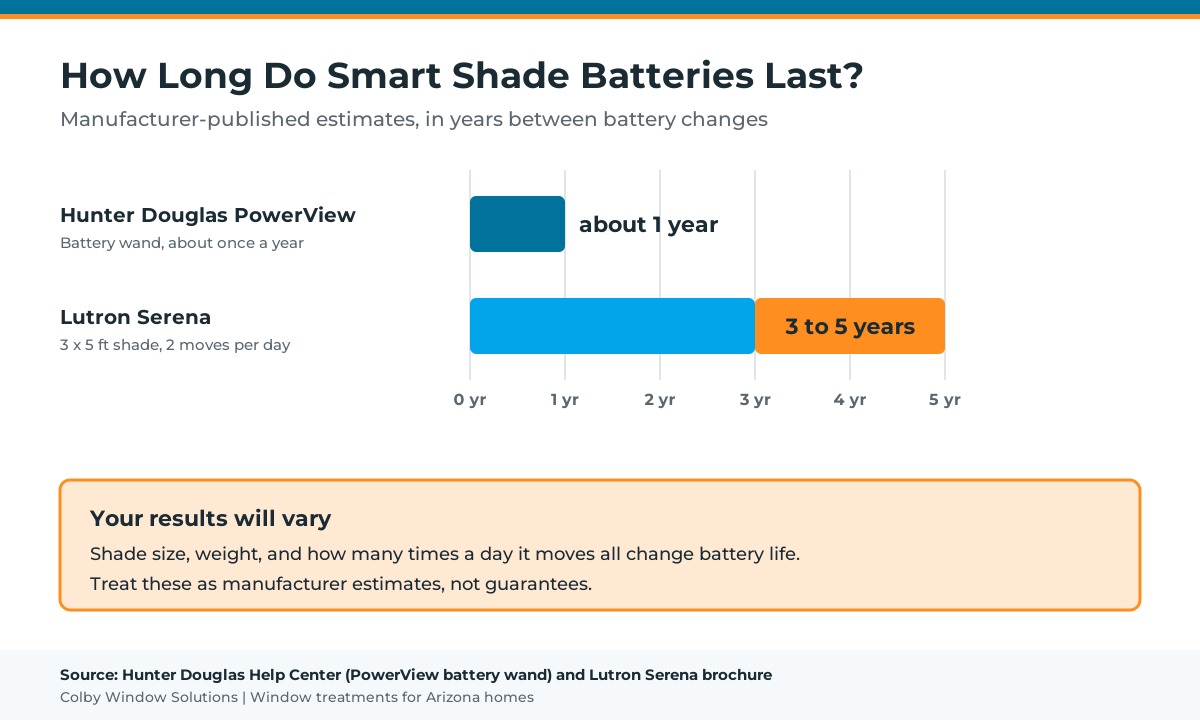
Usage matters as much as the brand. A shade on a daily schedule that moves twice a day drains faster than one you adjust by hand. Lutron’s battery guidance also warns that some third-party integrations can generate heavy wireless traffic that drastically shortens battery life, so keep your automation simple.
How to Know When a Shade Battery Is Low
Most systems warn you before a shade stops. Hunter Douglas PowerView shades, for example, blink an LED at the end of a move, show a battery icon in the app, and can send a low-battery email. Set up those alerts, or put a twice-a-year reminder on your calendar, so a dead battery never surprises you.
Rechargeable and Solar-Assisted Battery Options
Rechargeable wands avoid buying cells and usually detach from the headrail to charge. Some brands also offer a small solar panel that tops up the battery on sunny windows. Neither removes the battery altogether, but both reduce how often you handle one.
Do Motorized Blinds Need to Be Plugged In?
No, motorized blinds do not always need to be plugged in. Battery-powered models need no outlet, plug-in models run from a 120V outlet through a transformer, and hardwired models connect to low-voltage wiring that your installer routes to a power supply. The right one depends on how much wall work you are willing to do.
Smart Home Control and Energy Savings With Either Power Type
Both power types can run the same schedules, scenes, and voice commands, so power source should not decide your automation. The Department of Energy lists programmed scheduling, smart thermostat integration, voice command, and sensor-driven control as the main ways to automate shades. Most major motor brands connect to Alexa, Google Assistant, and Apple Home through a hub, but support varies by brand and model, so confirm before you buy.
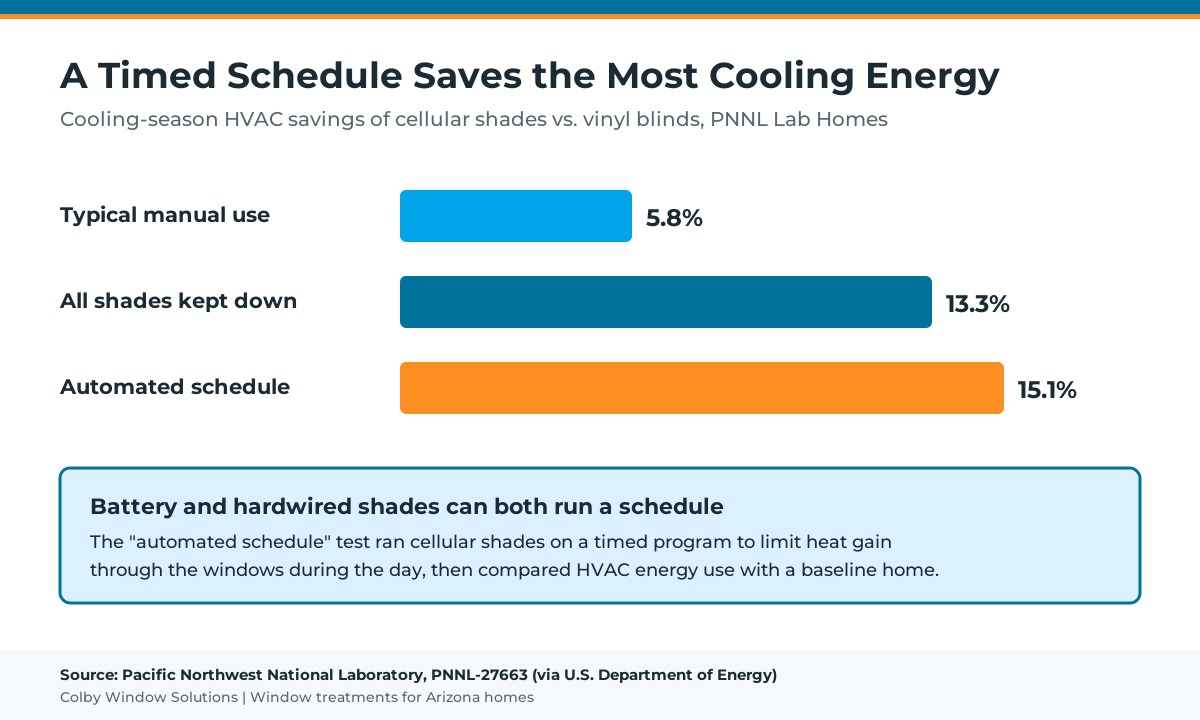
Automation is where the energy payoff comes from. In Pacific Northwest National Laboratory Lab Homes testing, a home with cellular shades on a timed schedule used about 15 percent less cooling-season HVAC energy than a home with vinyl blinds used the typical way, while cellular shades used the typical way saved about 6 percent. A shade that closes itself before the afternoon sun hits a west-facing window does not depend on anyone remembering.
What Do Battery and Hardwired Smart Shades Cost?
Battery systems cost less upfront because they need no electrical work, while hardwired systems add wiring, a power supply, labor, and possibly wall repair. Exact numbers depend on your window count, shade sizes, and wiring route, so a measurement beats a general estimate. See what window treatments cost for pricing context, then ask us for a quote that fits your home.
| Cost driver | Battery | Hardwired |
|---|---|---|
| Shade and motor | Motor and battery pack included | Motor plus power supply and controls |
| Wiring and electrical labor | None | Required, and an electrician may be needed |
| Wall repair and paint | None | Likely in a finished home |
| Ongoing cost | Replacement batteries or recharging | None for power |
| Window count | Cost scales per shade | One power supply can serve several shades |
If you want to spread out a larger project, ask about financing options.
How Battery and Hardwired Smart Shades Behave in a Power Outage
Battery-powered shades keep working in a blackout because the motor carries its own power, while plug-in and hardwired shades stop where they are until power returns or a backup source takes over. That is the one place hardwired power is not the steadier choice. If a stuck-open shade on a west-facing window would be a problem in your home, put battery power or a backup on that window.
How to Choose Between Battery and Hardwired Smart Shades
Match the power type to each window instead of choosing one system for the whole house. This short process covers most homes.
- Check your wall access: finished walls point to battery, open studs point to hardwired.
- Note each shade size and weight, and confirm the motor can handle it on battery power.
- Count how often each shade will move per day, since frequent moves drain batteries faster.
- Decide how much a stuck shade during a blackout would matter at that window.
- Get a measurement so your installer can confirm the motor and power type for every window.
| Your situation | Best fit | Why |
|---|---|---|
| Finished home, retrofit | Battery-powered | No wall cutting and a quick install |
| New build or major remodel | Hardwired low-voltage | Wiring is cheap while walls are open |
| Wide, tall, or grouped shades | Plug-in or hardwired | Larger sizes need steadier power, per DOE guidance |
| West-facing room that must stay shaded | Battery, or hardwired with backup | Keeps working if power drops |
| Mixed house, some open walls | Hybrid of both | Use each where it fits |
For wide shades, our motorized roller shade styles can be motorized on either power type, depending on size.
Smart Shade Installation in Pinal and Maricopa Counties
At Colby Window Solutions, our in-house installation team measures, installs, and configures smart shades for homeowners in Mesa, Gilbert, Chandler, Queen Creek, San Tan Valley, Apache Junction, Florence, and Casa Grande. Check our Pinal and Maricopa County service areas to confirm we cover your neighborhood.
- Visit our Mesa showroom to compare fabrics, motors, and controls in person.
- Call or book online with our Florence office, which handles phone and online consultations only, with no walk-ins.
Battery vs Hardwired Smart Shades FAQs
What are the downsides of motorized blinds?
The main downsides are a higher upfront cost than manual shades, battery upkeep on battery-powered models, and dependence on power for plug-in and hardwired models. Motors can also fail eventually, and not every model has a manual override, so ask about both before you buy.
Do motorized blinds need to be plugged in?
Not always. Battery-powered motorized blinds need no outlet, plug-in models run from a 120V outlet through a transformer, and hardwired models connect to low-voltage wiring and a power supply. Which one fits depends on your walls, your window size, and how much upkeep you want.
How often do battery-powered smart shades need to be charged?
It depends on the brand, shade size, and how often the shade moves. Hunter Douglas says its PowerView batteries generally need recharging or replacing about once a year, while Lutron lists 3 to 5 years for Serena shades under a specific test setup. Check your manufacturer’s estimate for your exact shade.
Can I convert battery-powered shades to hardwired later?
Sometimes, but it is rarely simple. Hardwiring means running low-voltage wiring to each window, and many brands need a different motor or power accessory for it. Compatibility varies by manufacturer, so if a hardwired future is possible, plan for it before the first installation.
Are hardwired smart shades worth the extra cost?
They are worth it when wiring is cheap to add, such as new construction or a remodel with open walls, or when you need to power several or larger shades. In a finished home, the cost of opening and repairing walls often makes battery-powered shades the better value.
Can battery smart shades be solar powered?
Some brands offer a small solar panel that tops up the shade’s battery, which works best on windows that get steady sun. It reduces how often you recharge but does not remove the need for a battery. Ask whether your shade and brand support a solar accessory.
Do battery and hardwired shades work with Alexa, Google Home, and Apple Home?
Most major motor brands connect to Alexa, Google Assistant, and Apple Home through a hub or bridge, and some support Matter. Compatibility depends on the brand and model rather than the power source, so confirm it before you buy.
Can I mix battery and hardwired shades in one home?
Yes. Many homes use hardwired shades in rooms with accessible wiring and battery-powered shades on finished walls or windows that are hard to reach with wiring. Your installer can group them under one app or hub if they share a compatible control system.
Get the Right Smart Shade Power Setup for Your Home
Battery power is the clean answer for most finished homes, and hardwiring is the smart move when the walls are open or the shades are big. We will look at your windows, confirm the motor and power type for each one, and give you a clear quote with no pressure. You can also book a free in-home measurement online.
Call (480) 617-0867 Schedule a Free Measurement