

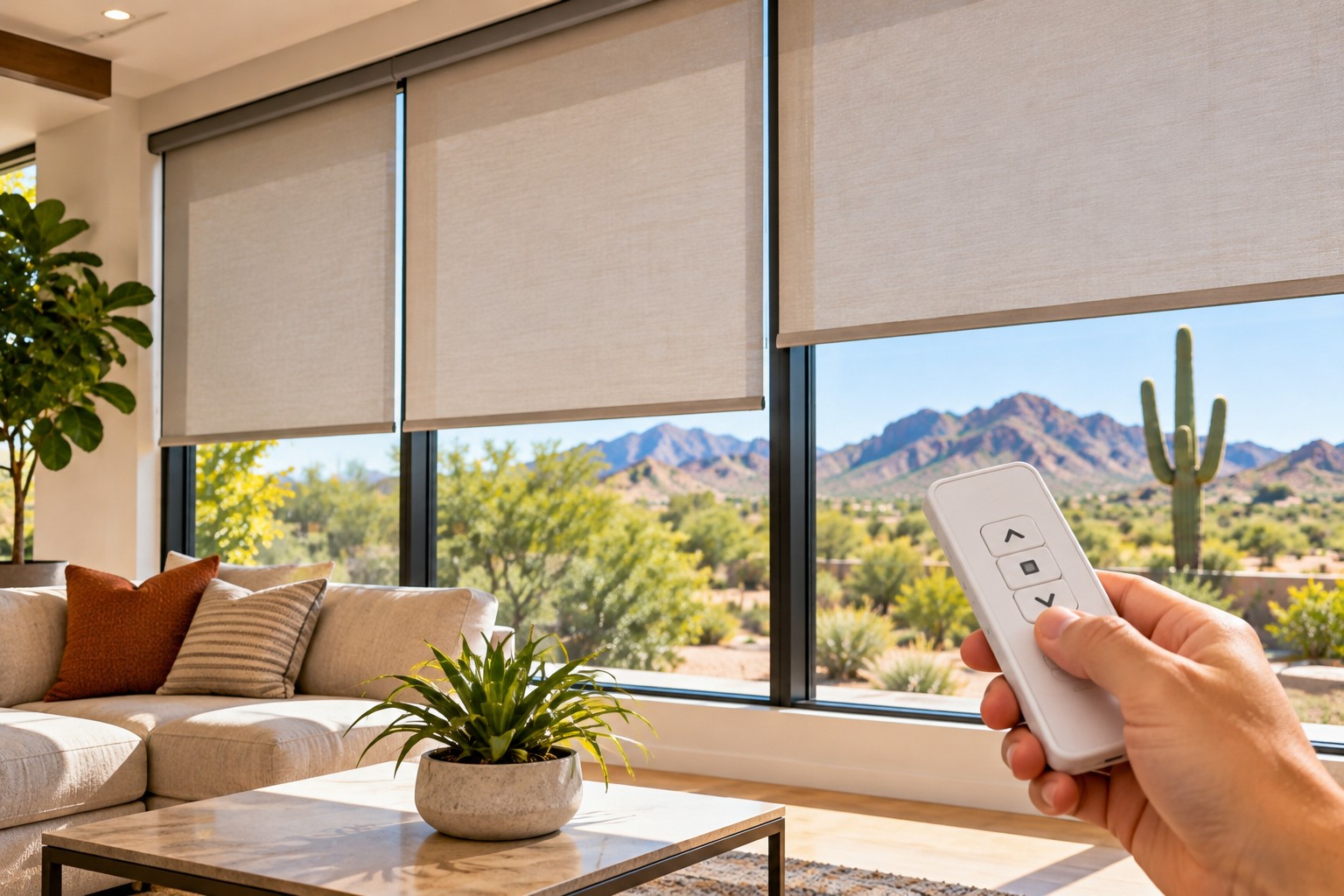
Motorized roller shades in Arizona solve a problem manual shades cannot: large windows that need constant adjustment in constant sun. A wide, heavy shade on a west-facing wall is hard to raise and lower, so it ends up left in one position all day. A motor fixes that, and in a climate where glass turns living rooms into heat traps, that matters.
Since 2009, Colby Window Solutions has helped Arizona homeowners choose shades that fit their windows, exposure, and budget. The prices, power options, and energy figures here come from published cost guides and federal research.
Are Motorized Roller Shades in Arizona Worth It for Large Windows?
Yes, for most large windows: motorized roller shades in Arizona are worth the extra cost when the glass is wide, tall, hard to reach, or faces west, because a shade only protects your home if it actually moves.
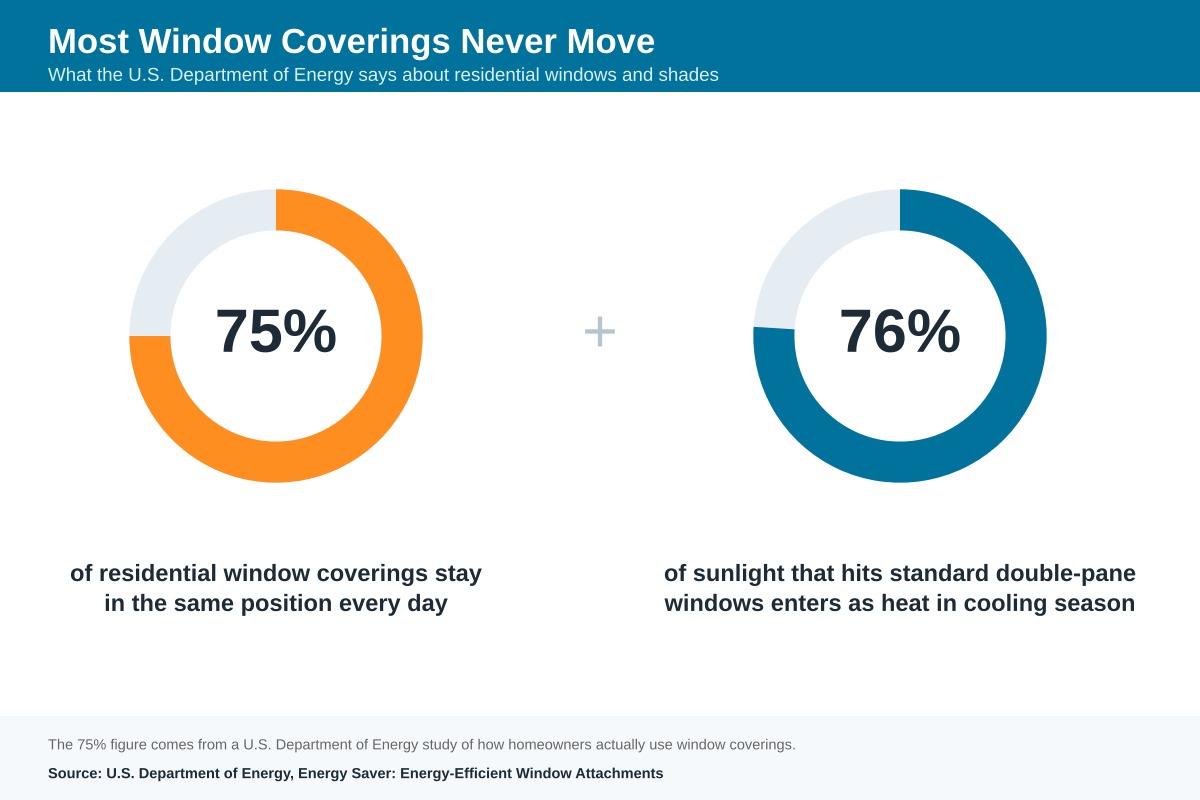
The U.S. Department of Energy found that 75% of residential window coverings stay in the same position every day, while about 76% of the sunlight hitting standard double-pane windows becomes heat in cooling season. A motor, a timer, or a sensor closes that gap. If you are also weighing custom roller shade options, motorization is the upgrade that most changes how often the shade gets used.
Motorization pays off fastest when your windows involve any of these:
- Spans wider than a person can comfortably operate by hand
- Floor-to-ceiling glass and sliding glass walls
- High windows over stairs, entries, and tubs
- West- or south-facing rooms with heavy afternoon sun
- Several adjacent windows that should move together
Manual vs Motorized Roller Shades for Large Windows
Manual shades work until the window gets big. Wider spans mean more fabric on the tube, more weight on the clutch and chain, and more effort every time you adjust, so people stop adjusting.
| Factor | Manual roller shade | Motorized roller shade |
|---|---|---|
| Daily use on wide windows | Heavy to operate, often left in one position | One touch, stops at any height |
| Hard-to-reach windows | Wands or long chains | Remote, wall switch, app, or voice |
| Several windows in a row | Adjusted one at a time, easy to end up uneven | Grouped so they move together |
| Cords | Chain loops | Cordless operation |
| Upfront cost | Lower | Higher, with the motor as the main difference |
| Power | None | Battery, plug-in, or hardwired |
When Manual Roller Shades Still Make Sense
Manual shades are a good fit for small windows you can reach easily, rooms where you adjust the shade a few times a year, and projects where budget matters more than convenience. They need no power and have nothing to charge.
When Motorized Roller Shades Win
Motorized shades win once windows are wide, tall, or central to how comfortable a room feels. The more often a shade needs to move, the more a motor is worth. Grouped control also keeps a wall of windows looking uniform instead of each shade sitting at a different height.
How Much Do Motorized Roller Shades Cost?
Motorized Roller Shades in Arizona: Cost per Window
Installed motorized shades typically cost $300 to $1,000 per window, with an average near $650 and about half of that going to the motor, according to HomeAdvisor’s electric blinds cost guide. Angi’s window treatment cost guide puts the motorization or smart-feature upcharge at $150 to $1,200 per window depending on the system.
Multiplying the $300 to $1,000 range by window count gives a realistic budget. These are estimates, not quotes.
| Project | Windows | Estimated installed cost |
|---|---|---|
| One large picture window | 1 | $300 to $1,000 |
| Great room wall | 3 | $900 to $3,000 |
| Open-plan living area | 6 | $1,800 to $6,000 |
| Whole home | 10 | $3,000 to $10,000 |
Wide shades with heavier fabric need stronger motors, so large-window quotes tend to land in the upper half of these ranges. For comparisons across every product, see the full price ranges for blinds, shades, and shutters.
Get a Motorized Shade Estimate
What Pushes Large-Window Cost Up
- Width and drop: more fabric means a larger tube and a stronger motor
- Fabric weight: blackout and dense fabrics weigh more than light-filtering weaves
- Power type: battery is simplest, while hardwired adds electrical work
- Controls: a remote costs less than a hub, app, and voice setup
- Window count: a few windows cost more per window than a full set
- Access: high windows and tight pockets add installation time
Power Options for Large Motorized Roller Shades
The right power source depends on shade size, whether the home is new or existing, and how many shades you are running. The Department of Energy’s Better Buildings guidance lays out the tradeoffs.
| Power type | Best for | Watch for |
|---|---|---|
| Battery | Existing homes, easy installation, hidden power pack, lowest cost to motorize | Batteries need replacing, and battery power does not suit some larger shades |
| Plug-in | Larger windows, steady power from a standard 120 volt outlet | Needs an outlet near the window and a hidden cord run |
| Hardwired | New construction and remodels, multiple large shades, clean look | Costly to retrofit into finished walls, and some areas require an electrician |
For a single oversized shade in an existing home, plug-in or hardwired power can be the better fit. For a few standard-size shades, battery power keeps the job simple.
Smart Controls and Automation for Large Windows
Motorized does not have to mean automated, but automation is where large windows gain the most. The Department of Energy describes three levels: manual, motorized, and automated, with control through remotes, programmed schedules, smart thermostat integration, voice commands, and sensors. We install app and voice-controlled shade systems with scheduling and grouped control.
A simple schedule solves the biggest Arizona problem: lowering west-facing shades before afternoon sun arrives and raising them when it passes. Grouped scenes let one button set an entire wall of windows.
How Much Energy Can Automated Shades Save?
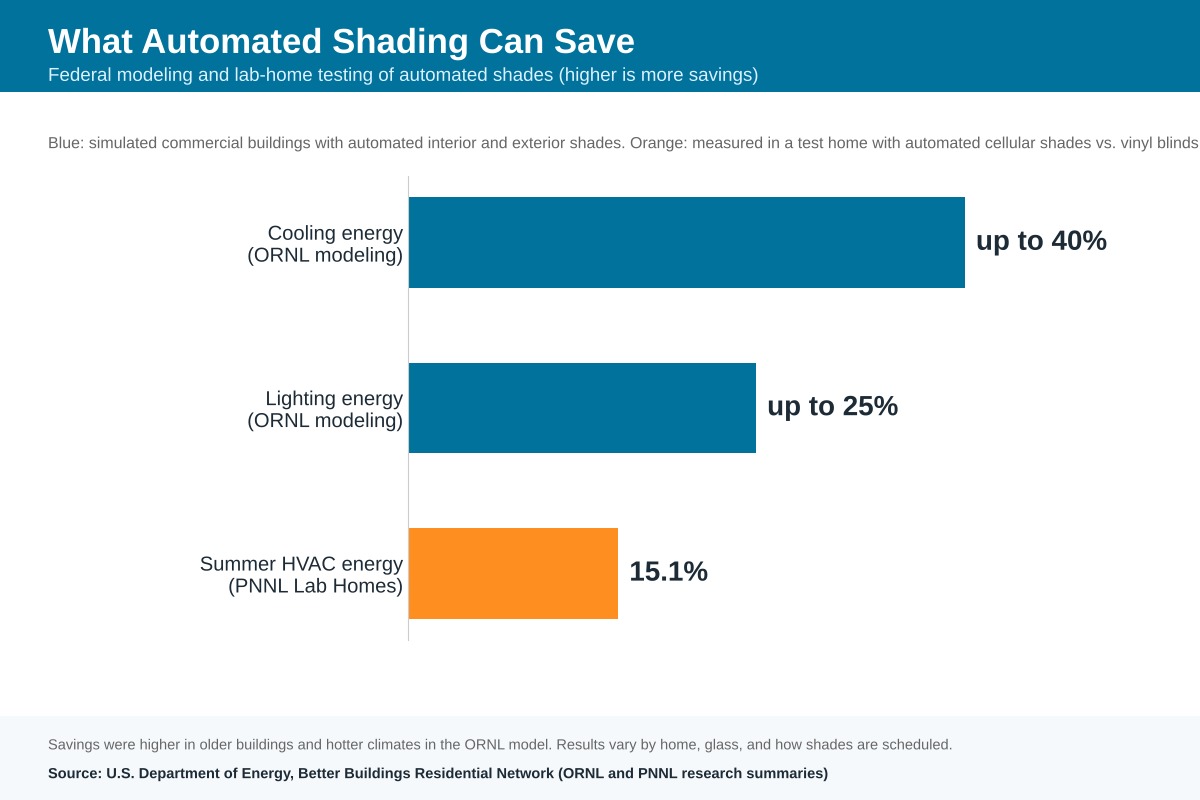
Federal research shows real potential, with limits. Oak Ridge National Laboratory modeling of automated shading in commercial buildings found cooling energy savings up to 40% and lighting savings up to 25%, with higher savings in older buildings and hotter climates. In Pacific Northwest National Laboratory test homes, scheduled automated cellular shades cut summer HVAC energy by 15.1% compared with typical use of vinyl blinds. Your result depends on your glass, your exposure, and how the shades are scheduled.
Shades control light and heat at the window, while film works on the glass itself all day. For glass that is difficult to cover, many Arizona homes pair shades with solar control film.
Cordless Safety: Why Motorized Roller Shades Help
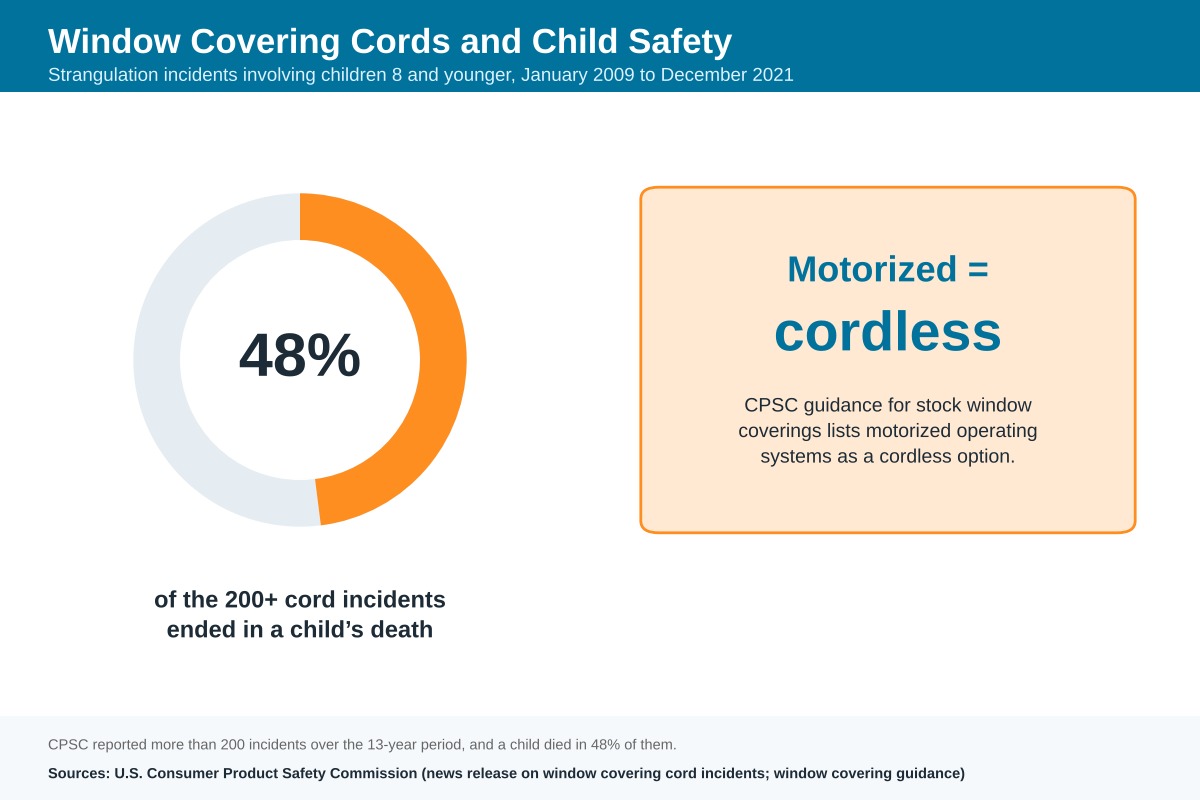
The Consumer Product Safety Commission reported more than 200 incidents involving children up to 8 years old and window covering cords from January 2009 through December 2021, and a child died in 48% of them. CPSC guidance on operating cords on stock window coverings lists motorized systems as a cordless option, which is why a motor is a practical safety upgrade in homes with young children or pets.
Which Roller Shade Fabric Works Best on Large Arizona Windows?
Fabric choice controls how much heat, glare, and view you keep. The Department of Energy notes that a higher openness factor increases visibility and light but reduces protection against glare and solar heat gain. Browse our solar screen fabrics to compare openness levels.
| Fabric type | Best for | Tradeoff |
|---|---|---|
| Low-openness solar screen (1% to 3%) | West and south glass, strongest heat and glare control | Darker view out |
| Higher-openness solar screen (5% to 10%) | View windows with moderate sun | Less heat blocked |
| Light-filtering fabric | Soft daylight and daytime privacy | Little heat control |
| Blackout fabric | Bedrooms, media rooms, and night privacy | No view when closed |
Many large rooms use two layers: a solar fabric for daytime sun and blackout or light-filtering for evenings.
Best Rooms for Motorized Roller Shades
- Living rooms and great rooms with wide windows
- Open-plan spaces with sliding glass walls
- Primary bedrooms with tall or wide spans
- Home offices with screen glare
- Stairwells and entries with high windows
- Any west-facing room that overheats by mid-afternoon
We install across the Phoenix-area communities we serve, and each project starts with measuring the windows and checking the power options for your home.
Get a Motorized Roller Shade Quote in Arizona
The most accurate price comes from measuring your windows and matching the motor, fabric, and controls to the room. Request a consultation and Colby Window Solutions will review your windows, power options, and goals, then quote each room. Our team is licensed, bonded, and insured under Arizona ROC 342512, and you can spread the cost with monthly payment options.
Prefer to see samples in person? Visit our Mesa showroom, or book a phone or online consultation with the Florence office. We are available Monday through Friday from 8 AM to 5 PM and Saturday from 8 AM to noon.
Request Your Motorized Shade Estimate
Motorized Roller Shade FAQs
How much do motorized roller shades cost per window?
Installed motorized shades typically cost $300 to $1,000 per window, with an average near $650, according to HomeAdvisor. About half of that goes to the motor. Large, heavy shades tend to land in the upper half of the range.
Are motorized roller shades worth it for large windows?
Usually yes. Wide, tall, hard-to-reach, and west-facing windows are the ones that benefit most, because a motor makes the shade easy to move. The Department of Energy found 75% of window coverings stay in one position every day, and motorization is the simplest way to break that habit.
Do motorized roller shades need batteries or wiring?
They can use batteries, a plug-in power supply, or hardwired power. The Department of Energy notes battery power is easy to install in existing homes but does not suit some larger shades, plug-in power can run larger windows, and hardwired power works best when planned during construction.
Can I control motorized roller shades with my phone or voice?
Yes. Control options include remotes, wall switches, programmed schedules, smart thermostat integration, voice commands, and sensors, depending on the system you choose.
Are motorized roller shades safer for children and pets?
Motorized shades remove the pull cords that cause window covering strangulation hazards. The Consumer Product Safety Commission lists motorized systems as a cordless option for stock window coverings.
Do motorized shades lower my cooling costs?
They can. Oak Ridge National Laboratory modeling found automated shading cut cooling energy up to 40% in commercial buildings, and Pacific Northwest National Laboratory test homes saw 15.1% summer HVAC savings with scheduled automated shades versus vinyl blinds. Real results depend on your glass, exposure, and schedule.
Which windows should I motorize first?
Start with west-facing and other sun-heavy windows, then any windows that are high or hard to reach. Those are the shades you are least likely to adjust by hand, so they gain the most from a motor.